Before You Boost a Post or Run Ads: Four Things to Fix First
Before you boost a post or run ads, fix four things: your first screen says what you do and where, your phone number can be tapped, your site shows a starting price or how you quote, and you have real photos of your work. Ads send people to those pages, and a weak page turns paid visitors into lost money.
The ad at a glance
| Question | Answer |
|---|---|
| Who it is for | Small business owners thinking about boosting a post or setting up ads, and anyone who has done so and seen clicks but no enquiries. |
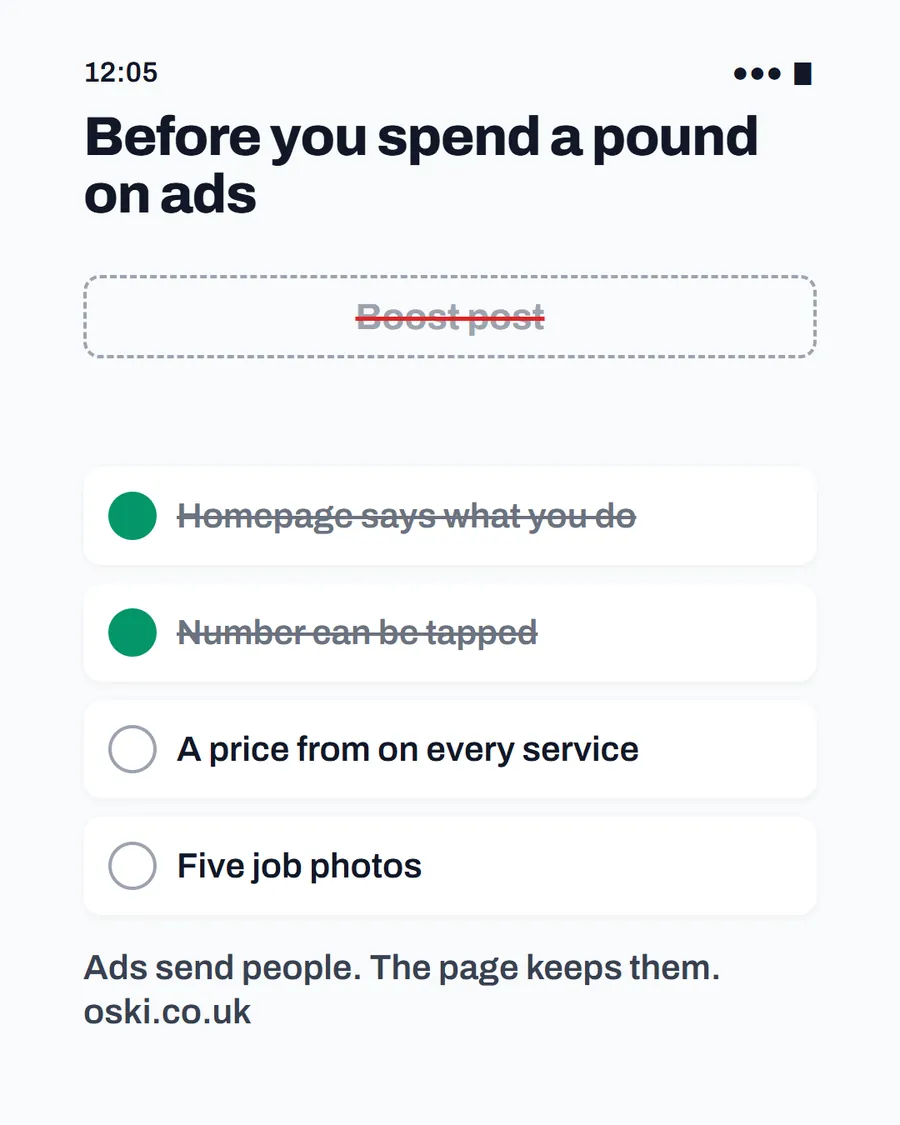
| What it shows | A reminders-style checklist headed "Before you spend a pound on ads", with a crossed-out "Boost post" button and four items: homepage says what you do, number can be tapped, a price from on every service, five job photos. |
| Where it applies | Across the UK, with a focus on London and the South East, where we are based. It is aimed at small local businesses wherever customers search for them. |
| Why we published it | Advice to fix the page first may cost us an ad job, but it is what we would tell a friend, and it makes any later ads work harder. |
Why fix the page before the ad?
Because the ad only brings people to the door. The page decides whether they come in. If a hundred people click an ad and the page does not say what you do, does not show your work and has a phone number they cannot tap, most will leave. You paid for each of them.
Fixing the page costs little, and it improves everything: your ads, your Google listing, your word-of-mouth enquiries. That is why we cover it ahead of the ad itself. Our post on Google Ads mistakes small businesses make lists the others.
What are the four checks?
Run these on your phone, as a customer would.
- Does the first screen say what you do and where? If it opens with "Welcome", rewrite it.
- Can the number be tapped? See how to check and fix it.
- Is there a price or an explanation of how you quote? Customers want to know roughly what to expect.
- Are there real photos of your work? At least five, on the homepage and key service pages.
If any of the four fails, fix it before you spend anything.
What else should be ready?
A few more things make a difference.
| Area | What to check |
|---|---|
| Contact routes | A form that arrives in your inbox and a phone that is answered |
| Reply speed | Someone who answers new enquiries the same day, ideally the same hour |
| Google listing | Photos, hours and reviews that match the website |
| Tracking | A way to know which enquiries came from the ad |
| Claims | Nothing in the ad you cannot prove |
Tracking is easy to skip and costly to leave out. Without it you cannot tell whether the money worked. Even a simple "How did you hear about us?" question on the form or phone call is a start.
What do UK advertising rules require?
Online ads in the UK have to follow the same rules as other advertising, including those on prices, claims and endorsements. The ASA offers a free standard Copy Advice service, which we explain in can the ASA check your ad before it runs. Keep every claim honest and provable, and be careful with words like "best". This is a general guide, not legal advice.
Is boosting a post different from running an ad?
A boosted post is a quick way to put an existing post in front of more people, and it is often the first paid step for a small business. It is simple, but it gives you less control than a full ad campaign over who sees it and what they do next. If a boosted post sends people to a weak profile, you have the same problem.
For a proper campaign, you choose a goal, audience and landing page. Our guide to Facebook and Instagram ads for local businesses explains the options. Either way, the four checks come first.
How do you decide how much to spend?
Start small and treat the first month as a test. Choose an amount you could lose without worrying, run one simple ad or boosted post to a local audience, and watch what happens to enquiries, not clicks. If you can trace jobs to the spend, increase gradually. If you cannot, pause and find out why before spending more.
Be honest about timing. A small, steady budget over several weeks usually teaches you more than a burst over a weekend.
What happens after someone clicks?
This is the part owners rarely think about. After the click, a visitor either rings, fills in a form, messages you or leaves. Plan for each. If they ring, who answers and what do they say? If they fill in a form, who sees it and how fast do they reply? If they message, who monitors the inbox?
Write down the answer for each route. A simple rule works well: every enquiry from an ad is answered within the hour during working hours. If you cannot meet that, run fewer ads until you can. Speed of reply is often what turns a click into a job, and it costs nothing.
How do you know it worked?
Decide in advance what success looks like. For a small trade business, it is usually a number of enquiries and, ideally, jobs. Pick a period, such as four weeks, and record each enquiry and where it came from. At the end, divide what you spent by the jobs won.
If the figure is acceptable, carry on and improve. If it is not, look at the page, the audience and the message before spending more. Be ready to stop if it clearly does not work, and put the money into fixing the basics instead.
What to do this week
- Open your site on your phone and run the four checks.
- Fix any that fail before you spend a penny on promotion.
- Add a "How did you hear about us?" question to your form and phone script.
- Check your listing photos, hours and reviews match your website.
- If you want a second view before you start, send us your web address and we will tell you what to fix first.
Frequently asked questions
Should I boost a Facebook post for my business?
Only once your page, website and contact routes are ready. A boosted post sends strangers to your profile, and if it is out of date or hard to contact you, the spend is wasted. Fix the basics first.
What should I fix before I run ads?
Check that your homepage says what you do and where, that your phone number can be tapped, that you show a price or how you quote, and that you have real photos of your work. Then check that someone answers every enquiry quickly.
How much should a small business spend on ads?
Start with an amount you can afford to lose while you learn, and increase only if you can see enquiries or jobs coming from it. Spend should follow evidence, not hope.
Do ads need to follow rules?
Yes. UK advertising rules apply to online ads, including claims, prices and testimonials. The ASA offers a free standard copy advice service, and we cover it in our guide to checking an ad before it runs.