
Do You Need a New Website, or Just Three Fixes? How to Decide
You probably do not need a new website yet if it still works but does not say what you do clearly. Rewrite the first line, add five real job photos and put a starting price on it, then decide. You do need a rebuild if you cannot edit the site, it fails on phones or its software is out of date.
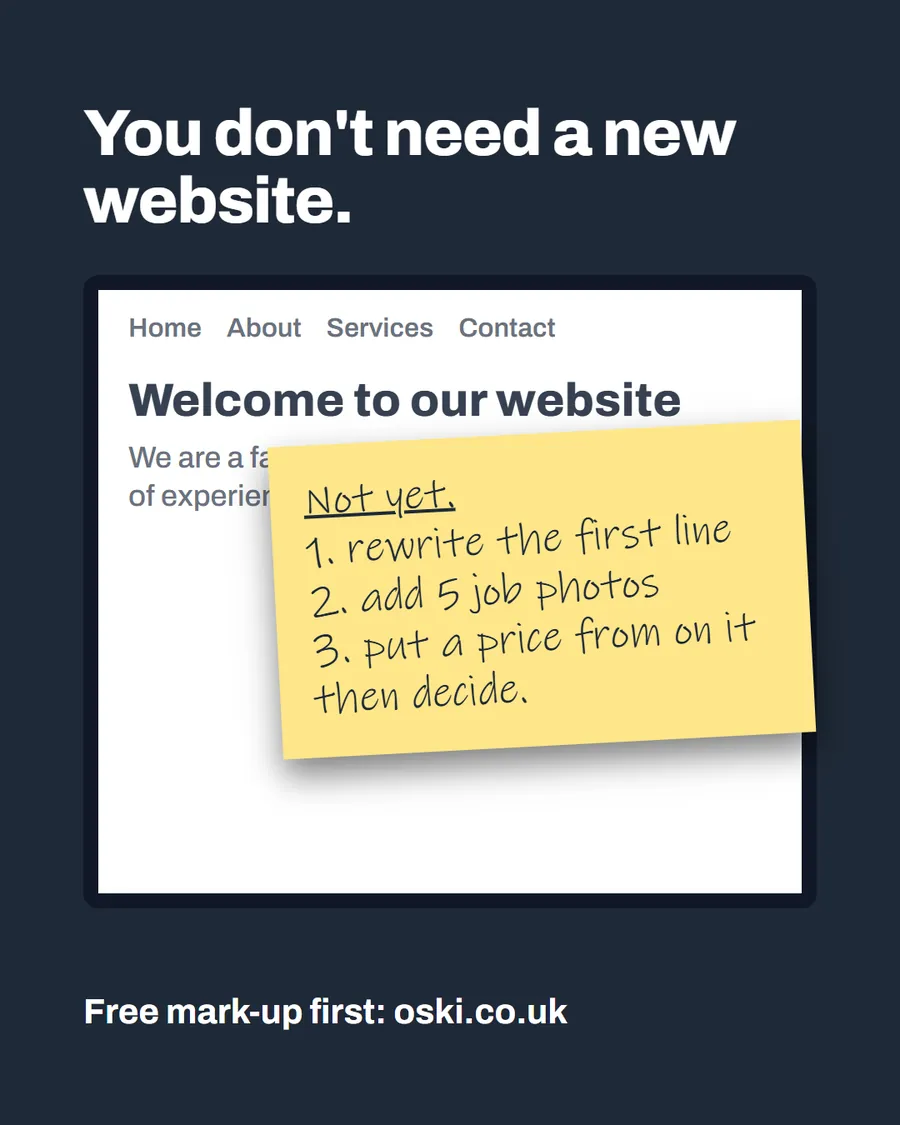
The ad at a glance
| Question | Answer |
|---|---|
| Who it is for | Owners who have been told they need a new website, or who suspect they do, and want to check before spending. |
| What it shows | A homepage on a monitor with a yellow sticky note listing three fixes, "rewrite the first line, add 5 job photos, put a price from on it, then decide", under the headline "You don't need a new website." The site is an example. |
| Where it applies | Across the UK, with a focus on London and the South East, where we are based. It is aimed at small local businesses wherever customers search for them. |
| Why we published it | Honest advice builds trust. If a three-line fix will do, we would rather say so than sell a rebuild. |
Why not just start again?
Because a rebuild costs money and time, and a new design built on the same weak words and photos usually brings the same weak results. If your old site never said what you do and where, a new one that looks better but says the same thing will not change much.
A rebuild is the right answer when the foundations are the problem. If the content is the problem, fixing the content is faster and cheaper. The sensible order is to fix what you can, see whether it helps, then decide about a rebuild with better information.
What are the three fixes to try first?
Do these in order, and give each a week.
- Rewrite the first line. Say what you do and where, in the words customers use. "Boiler repairs in Leeds" instead of "Welcome". Our guide on what the first line of your homepage should say shows how.
- Add five photos of real jobs. Replace stock images with your own finished work, as described in using photos of your work.
- Put a price from on it. A starting price or a clear explanation of how you quote. Check that it is accurate and not misleading.
Add a tappable phone number if you have not already. Then wait a few weeks and see whether enquiries change.
How do you tell whether the site is the real problem?
Run through these checks:
| Check | If yes | If no |
|---|---|---|
| Can you edit the text yourself? | Fine | A rebuild may be worth it |
| Does it work well on a phone? | Fine | Needs fixing or replacing |
| Does it load quickly? | Fine | Look at images and hosting |
| Is it built on supported software? | Fine | Update or rebuild |
| Does it say what you do and where? | Fine | Rewrite the words |
| Does it have a secure connection? | Fine | Fix it immediately |
If most answers are fine, the words and photos are likely your problem. If several are no, the platform may be.
What signs mean you do need a new website?
Some problems cannot be patched.
- You cannot update it. If every change needs a developer who has disappeared, you are stuck.
- It breaks on phones. Text that is too small, buttons that overlap or pages that do not fit the screen.
- It is very slow. Heavy images and old software make pages crawl, particularly on mobile data.
- It runs on unsupported software. Old systems can have security holes and stop working.
- It does not match the business. If you have changed what you do, a patched site can look confused.
In these cases a new site is a sensible investment. Our guide to what a small business website costs in the UK explains what to expect, and our website design services page describes what we build. Our published starting price for website design is from £1,600, one-off.
What should a good rebuild include?
If you do go ahead, ask for the things that make the new site work, not just look good:
- A clear first screen with trade, town, a real photo and a call button.
- A design that works well on phones.
- Pages for each main service and area, with real detail.
- A short contact form and a tappable phone number.
- You owning the domain and being able to edit the content.
- A plan for moving the old pages, so you keep what search engines already know about you.
Use our website launch checklist before the new site goes live.
What about an agency that says you must rebuild?
Ask why, and ask for the specific problems the rebuild would fix. A good answer lists them: no mobile design, no way to edit, old software. A vague answer, such as "it looks dated", is worth challenging, because looks alone are rarely the issue. If you want a second opinion, we are happy to give one, and we will tell you if you do not need us.
What to do this week
- Rewrite the first line of your homepage so it says what you do and where.
- Replace the largest stock photo with a real photo of a finished job.
- Add a starting price or a short explanation of how you quote.
- Run the six checks above and note any that fail.
- If you would like an honest view on whether to fix or rebuild, send us your web address.
Frequently asked questions
How do I know if I need a new website?
You probably do if you cannot edit it yourself, it is not usable on a phone, it loads very slowly, or it runs on software that is no longer supported. If it works but does not say what you do clearly, you may only need to rewrite parts of it.
What are the quickest fixes for an old website?
Rewrite the first line so it says what you do and where, add real photos of finished work, put a starting price or a clear explanation of how you quote, and make the phone number a tappable button.
How much does a new website cost?
It depends on what you need. Our published starting price for website design is from £1,600 one-off. Prices vary widely between providers, so compare what is included, such as mobile design, hosting set-up and revisions.
Should I fix my website before spending on ads?
Yes. Ads send people to your site, and if the site does not turn visitors into enquiries, you pay to lose them. Fix the basics first.