How Often Should a Tradesperson Post on Social Media?
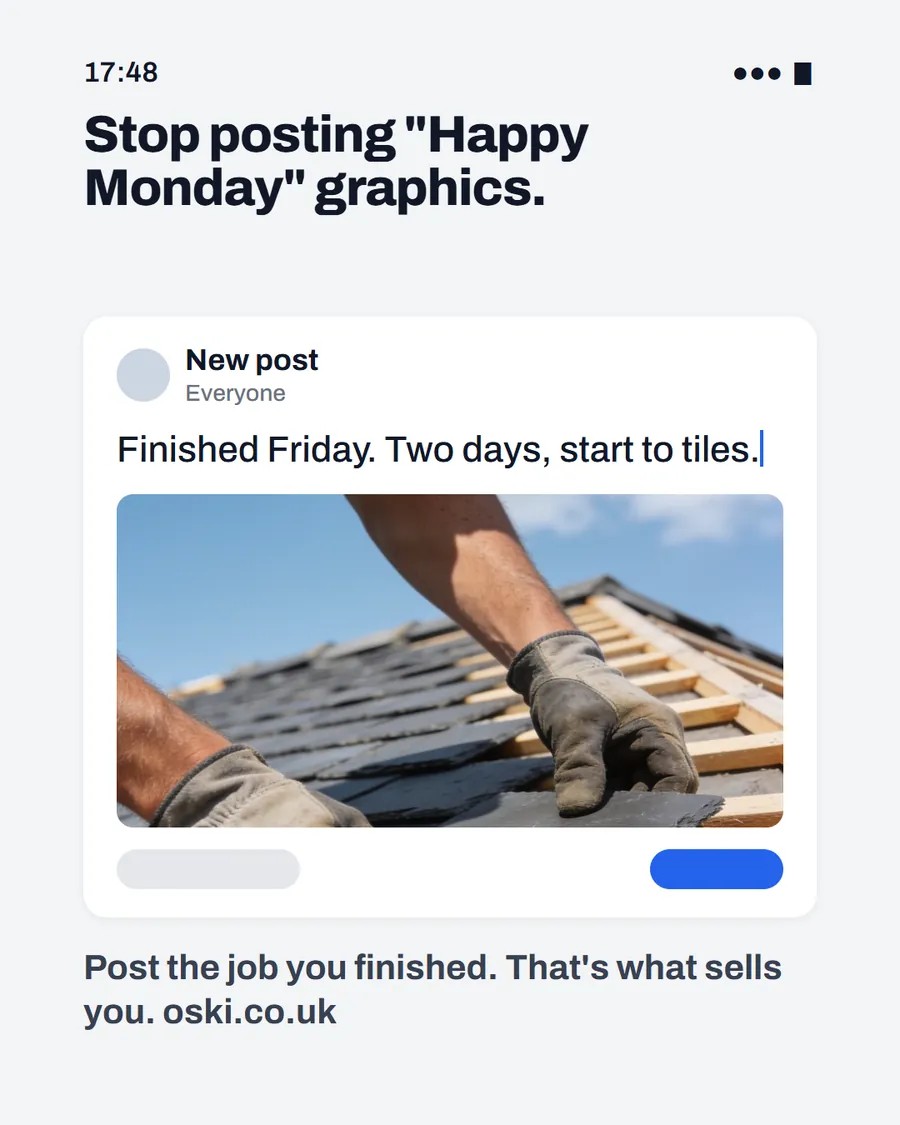
A tradesperson should post about once a week: one finished job, a clear photo and two lines of caption. That is enough to show customers you are active without eating your evenings. What matters most is the gap, because a profile whose last post is months old looks like a firm that has stopped trading.
The ad at a glance
| Question | Answer |
|---|---|
| Who it is for | Tradespeople and small local firms who set up a Facebook or Instagram page, posted for a few weeks and then went quiet. |
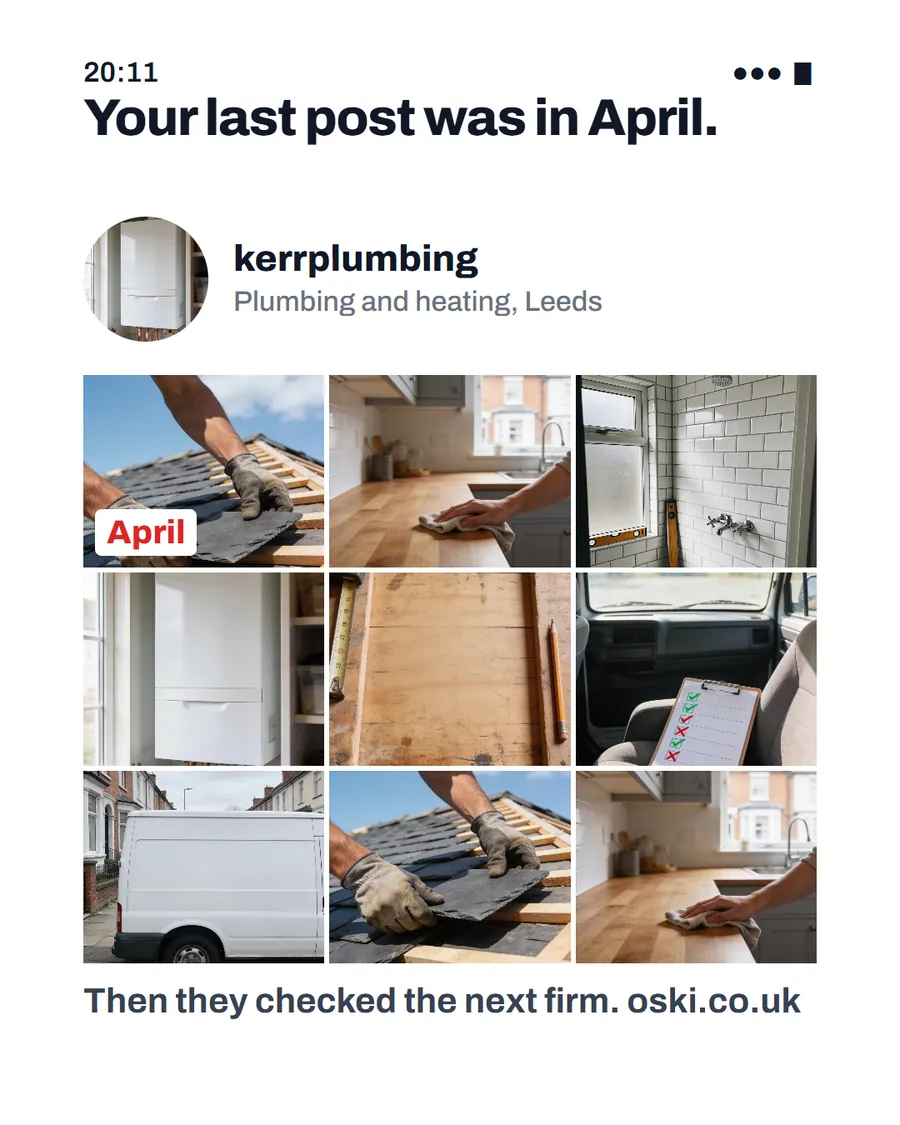
| What it shows | An Instagram-style profile grid of job photos, with the newest post tagged April, under the headline "Your last post was in April." The firm and handle in it are examples. |
| Where it applies | Across the UK, with a focus on London and the South East, where we are based. It is aimed at small local businesses wherever customers search for them. The example firm in the ad is set in Leeds, and the same advice applies in any town. |
| Why we published it | Customers check a profile before they ring, and the date of the last post is one of the first things they see. |
Why does a stale profile cost you jobs?
Because customers use your social page as a quick check that you are real and working. Someone who has been given your name opens the profile, scrolls the first few posts and looks at the dates. If the newest post is from last spring, the natural conclusion is that the business has slowed down or closed.
The photos matter as well. A profile that shows recent finished jobs suggests you are busy and proud of the work. One that shows the same few images from a year ago suggests the opposite. None of this is fair, but it is how people decide in a few seconds.
How often should a small trade business post?
There is no magic number, only a rhythm you can keep. Here is a simple guide by the time you have to give.
| Time you can spare | Rhythm | What it achieves |
|---|---|---|
| Almost none | One post a month | Proves you are still trading |
| Ten minutes a week | One finished job a week | A steady, believable feed |
| An hour a week | Two posts and a short video | More chances to be seen and remembered |
Start at the middle row. If you miss a week, do not try to make up for it by posting three times. Carry on the next week. A feed with a post every week or so for a year looks healthier than one with a burst and a long silence.
What should each post contain?
Use a simple formula that takes under two minutes once you have the photo:
- The photo. One finished job, clearly lit, with no faces or house numbers.
- What the customer asked for. "Replace an old boiler" or "Make the shower leak-proof".
- What you did. One sentence.
- The place. "Croydon" or the area you cover.
An example caption: "New combi boiler fitted for a customer in Croydon. Old system removed, new pipework tidied, handover done in an afternoon." That is all. It tells a visitor what you do, where and how you work. We cover more ideas in what to post on Facebook and Instagram.
How do you find the time?
Take the photo at the job, not later. Put "photo" on your end-of-job checklist, so you do it before you drive off. Then once a week, on the same day, pick the best photo and write the caption. If you use a phone, both Facebook and Instagram let you schedule a post, so you can write on a Friday and have it go out on Monday.
If even that is too much, use a monthly batch: spend half an hour on the first of the month choosing four photos and scheduling them. It is better to have a plan you can keep than an ideal you will drop.
What should you post when there is nothing new?
Not every week brings a photogenic job. Keep a short list of backups:
- A question a customer asked and your answer. "Why is my boiler making a noise?" works well.
- A seasonal reminder. Boiler services before winter, gutter checks in autumn.
- A before and after from earlier in the year. Say so in the caption.
- A tidy picture of the van or your tools. It shows who customers will meet.
If you want more on the video side, our guide to Instagram Reels for local businesses covers it.
Where does social media rank against your other marketing?
Behind your Google listing and your website. A customer who finds you through a search will check those first, and an out-of-date social page matters less than a wrong phone number or empty listing. Fix the basics first, then add the weekly post. Our social media guide for tradespeople explains how the pieces fit together.
What should you avoid posting?
A few habits waste effort or damage trust:
- Generic quote graphics. "Happy Monday" cards and motivational quotes say nothing about your work, and customers scroll past them.
- Anything that identifies a customer without permission. Faces, house numbers and addresses stay out.
- Complaints about customers or other firms. Even when you are right, it reads badly.
- Old prices. If a post shows a price, it needs to stay true or be taken down.
- Posts that are really ads for yourself. A photo of real work is persuasive. A block of text about how great you are is not.
If you are unsure, ask whether the post shows something a customer would want to see before hiring you. If the answer is no, skip it.
How do you know whether posting is working?
Do not judge it by likes. A trade business does not need thousands of followers, and likes rarely turn into jobs. Look for smaller signals: someone mentioning a post when they ring, a message from a past customer, or a profile visit before an enquiry.
Add one question to your first call or form: "How did you hear about us?" Keep a tally. After three months you will see whether social media, Google, word of mouth or something else is sending the work. If social media never appears, spend less time on it and more on your listing and website. If it does, keep the weekly habit going.
What to do this week
- Open your profile and find the date of your last post.
- Pick one finished job from the last month and take or choose a clear photo.
- Write the four-part caption and post it.
- Decide on your rhythm: monthly, weekly or twice a week, and put it in your diary.
- If you want us to plan a month of posts from your real work, send us a message.
Frequently asked questions
Is it better to post every day or once a week?
Once a week that you keep up beats every day for two weeks and then nothing. Customers mostly want to see that the business is active and the work is recent, so steady and simple wins over frequent and exhausting.
What happens if I stop posting for a few months?
Nothing dramatic happens to the account, but a visitor who checks your profile sees an old last post and may assume you have stopped trading. You can recover quickly by posting one finished job and then keeping a light weekly habit.
Should I post on Facebook, Instagram or both?
Pick the one your customers use and do that properly first. Many small firms post the same photo and caption on both, which saves time. Do not spread yourself across more platforms than you can keep up.
Do I need to pay for ads to get seen?
No. Organic posts reach people who already follow you or find you through a search of your profile, and that is enough for proof of activity. Paid ads are a separate decision, and we explain what to fix first in our guide on boosting posts.