
Minimum Terms and Profile Ownership: Two Things to Check Before You Hire a Marketing Agency
Before you hire a marketing agency, check two clauses: how long you are tied in for, and who owns your Google profile and website. A long minimum term can leave you paying for work that is not helping, and an agency that owns your profile can take your reviews and listing with it when you leave. This is a general guide, not legal advice.
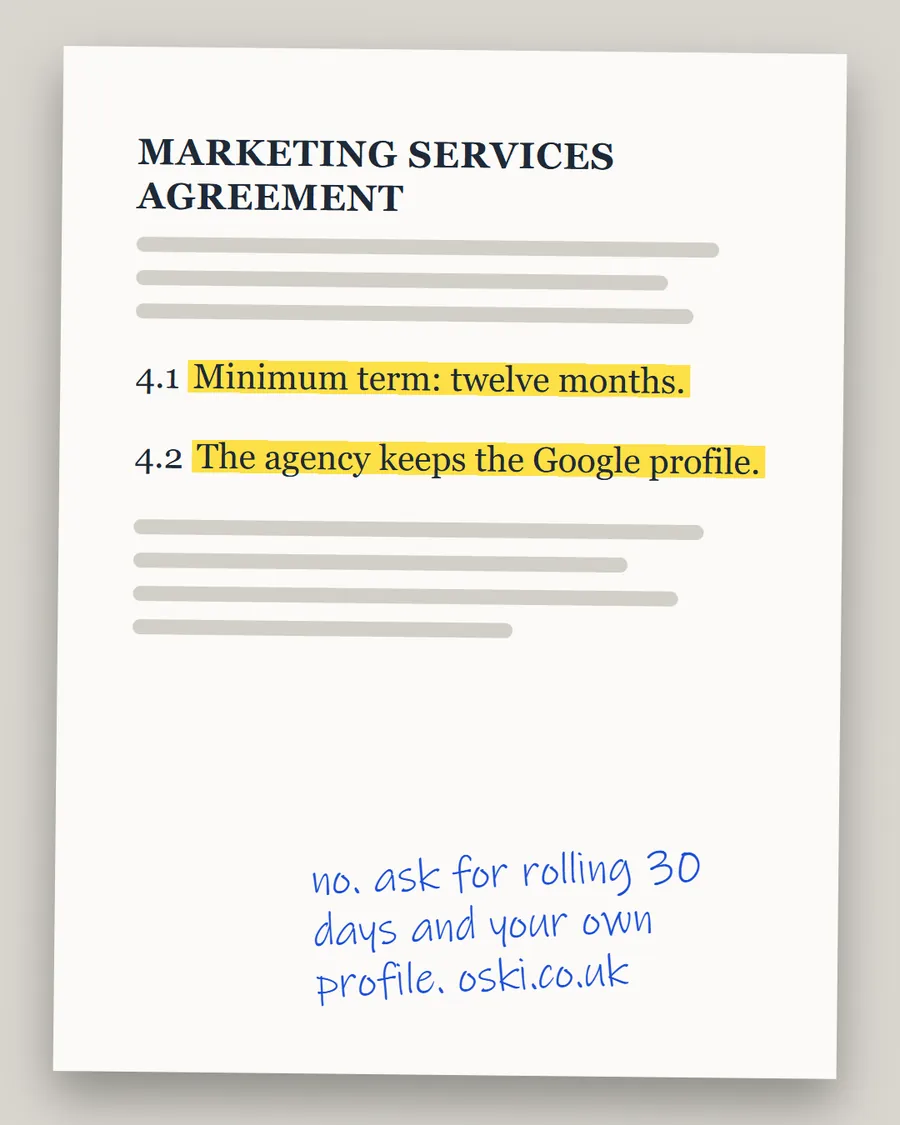
The ad at a glance
| Question | Answer |
|---|---|
| Who it is for | Owners about to sign with an agency, a freelancer or a "marketing person", and owners who suspect they have already signed something they cannot easily leave. |
| What it shows | A photographed contract page with two clauses highlighted in yellow: a twelve-month minimum term and the agency keeping the Google profile. A handwritten note in the margin asks for rolling 30 days and your own profile. The contract is an example, not a real agreement. |
| Where it applies | Across the UK, with a focus on London and the South East, where we are based. It is aimed at small local businesses wherever customers search for them. |
| Why we published it | These two clauses cause the most regret, and both are easy to ask about before you sign. |
What is a minimum term, and why does it matter?
A minimum term is the length of time you agree to pay for, whatever the results. Some agencies ask for six or twelve months, with renewal unless you give notice. The risk is simple: if the work is not helping in month three, you still owe months four to twelve.
A fair agency can explain why a term is needed, such as set-up work that takes time to pay back. Ask what you get in exchange, and whether there is an exit if the agency is not delivering what it promised. Rolling monthly terms with a short notice period put the pressure back on the agency to keep earning your business, which is how we run our retainers: rolling contracts with no lock-in.
Who should own your Google Business Profile?
You should. Your profile holds your reviews, photos and listing, which are built up over years. If an agency creates it under its own account and you part ways, you may lose all of it.
Google's help page on owners and managers says a profile can have owners and managers. Managers have nearly the same access as owners, but cannot add or remove users or remove the profile. That is exactly what an agency needs: enough access to do the work and no power to lock you out. Always set up the profile yourself, as owner, and invite the agency as a manager. We explain the wider point in who should own your website and Google profile.
Who should own your website and domain?
You should own the domain name, and the contract should say you own the site's content. Ask three questions:
- Is the domain registered in my name, with my email as the contact?
- If we part ways, can I take a copy of the site and all its content?
- Does hosting or a plugin licence tie me to this agency?
If the answer to any of these is no or vague, ask for it in writing before you sign.
What does a fair agreement look like?
| Clause | Looks fair | Raises a question |
|---|---|---|
| Term | Rolling monthly, short notice | Twelve months or more with auto-renewal |
| Ownership | You own the domain, site and profiles | Agency holds the accounts |
| Results | Honest about what is outside its control | Promises of page-one rankings or a set number of leads |
| Reporting | Plain-English report each month | "Available on request" |
| Exit | Handover of files and logins on leaving | Fees for returning your own accounts |
For a wider view, our guide on what to check in a marketing agency contract goes through the rest of the document.
Which red flags should make you pause?
Be wary of any agency that promises page-one rankings or a set number of leads, because nobody can control search results and an honest agency will not guarantee them. Also be cautious if the agency is reluctant to tell you who owns the accounts, or sends the contract only at the last minute. Our list of marketing agency red flags has more.
What if you are already tied in?
Start by reading the contract: the term, the notice period and what happens on cancellation. Then ask the agency in writing what they would do to help you if the work is not delivering. Many will talk when you raise it. Check whether the accounts, such as your Google profile and domain, are in your name. If they are not, ask for them to be transferred now, while the relationship is still good.
If you want to dispute payment or think a term is unfair, speak to a solicitor or an advice service before withholding anything, because this depends on the wording of your contract.
What questions should you ask before you sign?
Take this list to any agency meeting, and write down the answers:
- What is the minimum term, and what happens at the end of it?
- How much notice do I need to give to leave, and in what form?
- Who will own my Google Business Profile, website and domain?
- Will you work from my accounts, or yours?
- If I leave, how and how quickly do you hand over files and logins?
- What exactly will I receive each month, and in what format?
- What is included in the fee, and what costs extra?
- Who will actually do the work, and who do I speak to?
A good agency will answer these without hesitation. If it takes several attempts to get a straight answer, that tells you something too.
How do we handle these two clauses?
For clarity, here is how we work. Our retainers run on rolling contracts with no lock-in, so you can leave if the work is not helping. Ad spend is paid directly to the platform, not through us. You own your website, your domain and your Google Business Profile, and we only ever take manager access to the profile. We do not promise page-one rankings or a number of leads, because nobody can.
We say this so you can compare it with any proposal you receive, including ours. If another agency offers better terms, take them.
What to do this week
- Find your agreement, or the proposal you are considering, and highlight the minimum term and the notice period.
- Check who owns your Google Business Profile: sign in and look at the people with access.
- Check who owns your domain name and where it is registered.
- Write three questions about ownership and exit and send them to the agency.
- If you want a second opinion on a proposal, send it to us and we will tell you what we notice.
Frequently asked questions
What is a minimum term in a marketing agency contract?
It is the period you agree to pay for, usually whether or not you are happy with the results. It might be a number of months, with automatic renewal afterwards. Always ask what happens if you want to leave early and how much notice you must give.
Who should own my Google Business Profile?
You should. An agency only needs manager access to edit it. Google lets a profile have owners and managers, and managers can edit the profile but cannot add or remove users or remove the profile, which leaves you in control.
Who should own my website and domain name?
You should, and the contract should say so. Ask whether the domain is registered in your name and whether you can take a copy of the site and its content if you leave.
Is a rolling monthly contract better than a fixed term?
For most small businesses, yes, because you can leave if the work is not helping. A fixed term can make sense for a one-off project with a clear deliverable. Either way, read the cancellation clause and ask for it in plain English.