
Shared Leads: What to Do When Three Other Firms Get the Same Enquiry
A shared lead is an enquiry sent to several firms at once, usually for a fee. When three other firms get the same job, you are competing on speed and first impressions, and you pay whether you win or not. Work out your cost per job won, respond fast, and build routes where the customer comes only to you.
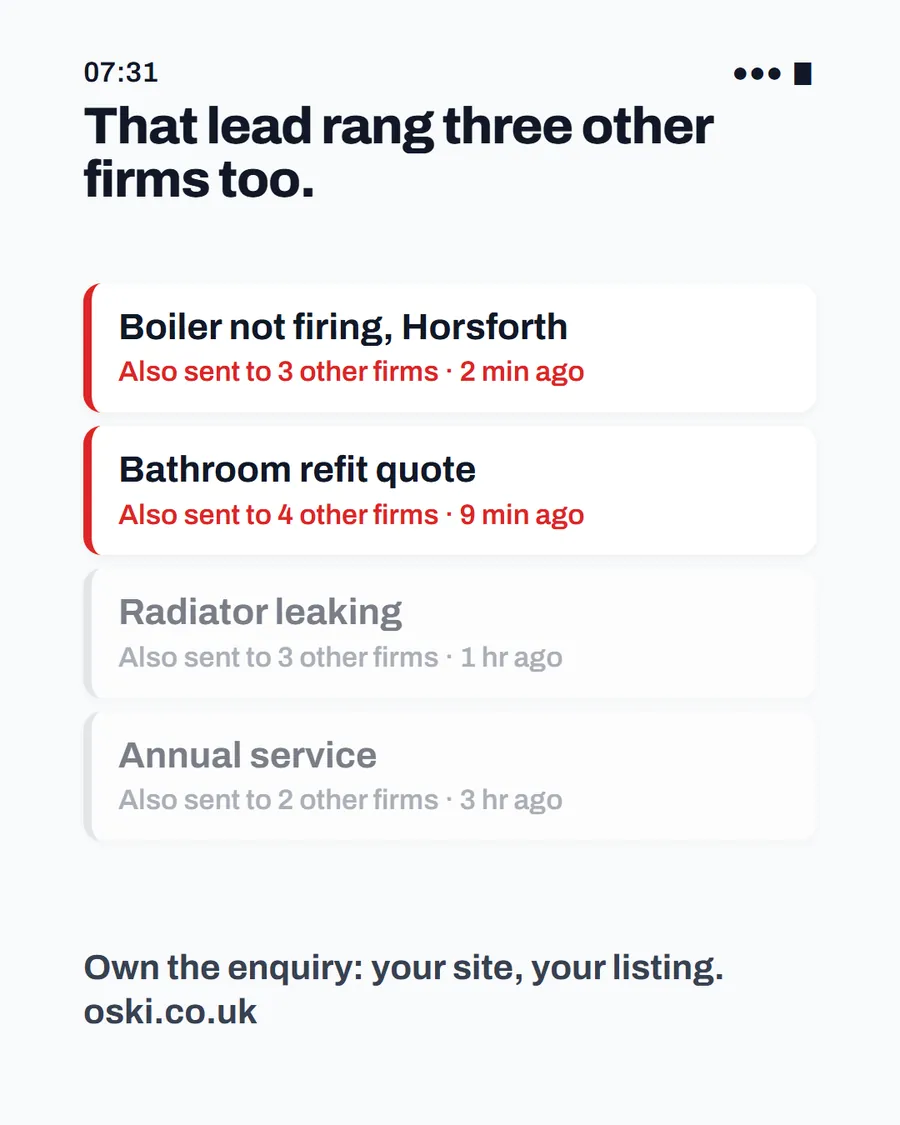
The ad at a glance
| Question | Answer |
|---|---|
| Who it is for | Tradespeople who buy leads from an online platform and feel they are paying to race other firms to the same customer. |
| What it shows | A lead inbox listing enquiries such as a boiler not firing and a bathroom refit quote, each marked "Also sent to" a number of other firms, under the headline "That lead rang three other firms too." No platform is named. The inbox is an example. |
| Where it applies | Across the UK, with a focus on London and the South East, where we are based. It is aimed at small local businesses wherever customers search for them. The example firm in the ad is set in Horsforth, Leeds, and the same advice applies in any town. |
| Why we published it | It describes a frustration owners already feel and points to a fix they can start on without leaving the platform: build enquiries that belong only to them. |
How do shared leads work?
A customer fills in a form on a site that connects people with local tradespeople. The platform sends the details to several firms, often charging each a fee when it does. Each firm then phones or messages the customer, and the customer chooses one. The platform earns from every firm that receives the lead, whether or not any of them get the job.
For the customer, this is efficient. For the firm, it turns every enquiry into a contest. You are competing on how fast you reply, how you sound and how your profile looks next to the others.
What does that do to your numbers?
It changes what a lead is worth. If three other firms also got the enquiry, your chance of winning is lower than if the customer had contacted you directly. You still pay the fee, and the more firms receive each lead, the more you rely on winning a fair share.
So the figure that matters is not the cost per lead. It is the cost per job won.
| Measure | How to work it out |
|---|---|
| Leads bought | Count them for the month |
| Leads you reached | The ones where you spoke to the customer |
| Jobs won | The ones that became paid work |
| Cost per job won | Total spent on leads divided by jobs won |
| Profit per job | Job value minus your costs, including time |
If the cost per job won is high compared with the profit, the platform is costing you more than it earns.
How can you win more of the leads you pay for?
Speed counts most. A customer who has just sent a form is looking at their phone, and the first sensible reply tends to set the tone. Set notifications so you see a new lead immediately, and have a short, friendly opening message ready: who you are, that you can help, and a question or a time to talk.
Then look at what the customer sees about you. A profile with real photos, recent reviews and a clear description beats one with none. Our post on why customers pick the site with photos and a price applies here too, because customers compare in the same way on a platform as they do on a website.
What does an enquiry that is only yours look like?
It arrives through a route you control: your website form, your Google listing, a phone call from someone who saw your van or a referral from a past customer. The customer has chosen to contact you, not been handed a list of five. They may be talking to other firms too, but you are not in a race that started when a form was submitted.
| Shared lead | Own enquiry | |
|---|---|---|
| Who else is contacted | Several firms | Often just you |
| Cost | Fee per lead | Time and a modest running cost |
| Speed of building | Immediate | Weeks to months |
| Control | Platform sets the terms | You set the terms |
| Value over time | Stops when you stop paying | Builds up, such as reviews |
How do you build your own enquiries alongside the platform?
You do not have to drop the platform. Use it while you build the routes that belong to you.
- Make your Google listing complete. Photos, hours, services and recent reviews, as in our Google Business Profile checklist.
- Make your website easy to act on. A clear first line, a tappable number and a short form.
- Ask every satisfied customer for a review. Reviews work on both your listing and the platform.
- Ask for referrals. A simple line at the end of a job: "If you know anyone who needs similar work, please pass my number on."
- Keep a list of past customers and contact them once or twice a year, politely.
Our guide to lead platforms versus your own marketing compares the two in more detail, and Google Local Services Ads is another route to look at.
When does a lead platform make sense?
When you have spare capacity, a quiet period or a new area to break into, and when your numbers show it pays. It is also useful for learning what customers ask for and how they respond. It makes less sense when you are already busy, or when your close rate is so low that the fees outweigh the work.
Review it every quarter with real numbers. If the cost per job won is rising, that is a signal to put more time into your own routes.
What to do this week
- Count the leads you bought last month, the jobs you won and the total you paid.
- Work out the cost per job won and compare it with the profit on an average job.
- Set up phone notifications so you can reply to new leads within minutes.
- Choose one own-enquiry route to improve this week, such as your Google listing photos.
- If you would like help building enquiries that are only yours, send us a message.
Frequently asked questions
What is a shared lead?
A shared lead is an enquiry sent to several businesses at once, often for a fee per lead. The customer fills in one form, and a number of firms are told about the job. The first to respond, or the one that looks best, usually gets it.
Are shared leads worth paying for?
They can be, if you win enough of them and your close rate covers the cost. Work out your cost per job won, not your cost per lead, and compare it with the work you get from your own website, Google listing and referrals.
How can I win more shared leads?
Respond quickly, ideally within minutes, with a clear and friendly message. Have a good profile on the platform and recent reviews. But also build routes where the customer comes to you directly, so you are not competing for every job.
What is the alternative to lead platforms?
Your own website, Google Business Profile, reviews and referrals. These take longer to build, but the enquiries are yours alone, and the cost does not rise every time a lead is sold again.