Can the ASA Check Your Ad Before It Runs? Copy Advice Explained
Yes. The ASA's Copy Advice service lets advertisers check a non-broadcast ad before it runs. The standard service is free and takes three to five working days, and faster paid options exist. Send the ad, where it will appear and the claims you want checked. This is a general guide, not legal advice.
The ad at a glance
| Question | Answer |
|---|---|
| Who it is for | Small business owners who run, or are about to run, ads or promotional posts and want to be sure they are within the rules. |
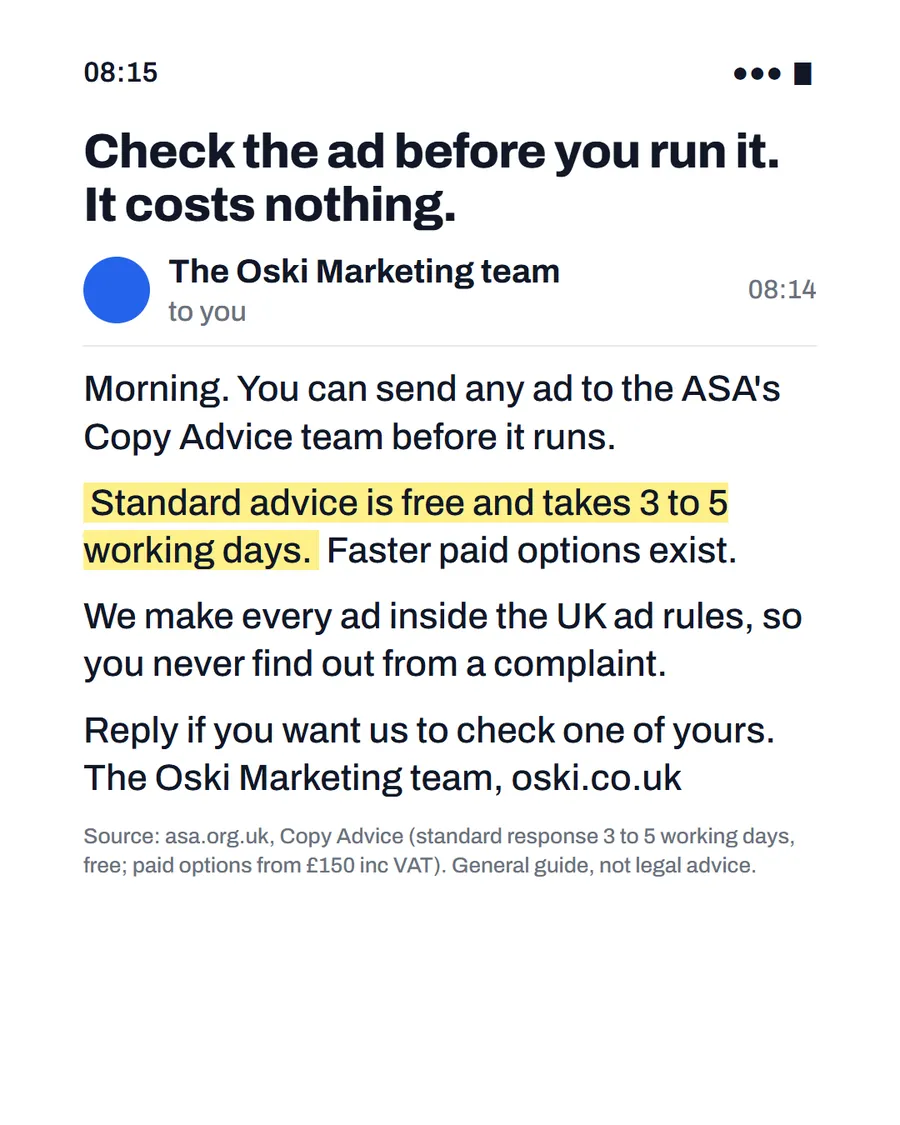
| What it shows | A mail screen with an email from our team headed "Check the ad before you run it. It costs nothing.", saying you can send any ad to the ASA's Copy Advice team, that standard advice is free and takes three to five working days, and that we make every ad inside the UK ad rules. |
| Where it applies | Across the UK, with a focus on London and the South East, where we are based. It is aimed at small local businesses wherever customers search for them. |
| Why we published it | Many owners do not know the service exists. Knowing it removes a common worry about running ads. |
What is ASA Copy Advice?
The Advertising Standards Authority (ASA) regulates advertising in the UK. Its Copy Advice team gives guidance on whether a planned ad is likely to follow the CAP Code, the rulebook for non-broadcast advertising. According to the ASA's Copy Advice page, the service is for advertisers, agencies, media owners and media service providers, and it covers non-broadcast advertising only. TV and radio enquiries go elsewhere.
Think of it as a second opinion before you publish, rather than a reaction to a complaint. It is a sensible step when you are unsure about a claim, a price or the wording of an offer.
What does it cost, and how long does it take?
The ASA's page describes a standard free enquiry with a response time of three to five working days. It also lists paid options for faster answers.
| Option | Response time | Cost at the time of writing |
|---|---|---|
| Standard | Three to five working days | Free |
| 48-hour | 48 hours | £150 including VAT |
| 24-hour | 24 hours | £300 including VAT |
| 4-hour | Four hours | £600 including VAT |
Prices may change, so check the ASA's page before relying on them. For most small businesses, the free service is enough if you plan ahead. Send your question a couple of weeks before a campaign, not the night before.
What kinds of claims should you check?
Anything a customer might rely on. The usual ones for a small business are:
- Prices. The ASA's advice on prices says that "from" claims must not exaggerate the availability or amount of benefits likely to be obtained, that price statements must relate to the product featured and that quoted prices should include non-optional taxes and charges.
- "Best", "number one" and similar. These claims usually need evidence, and we explain why in can I say best in my advertising.
- Testimonials and reviews. They must be genuine, and any incentive must not be hidden.
- Qualifications and accreditations. Only claim ones you hold, and be ready to prove them.
- Offers and deadlines. If an offer ends, say when, and honour it.
How do you prepare a good enquiry?
The clearer your question, the more useful the answer. Prepare:
- The ad itself, in the form it will appear, such as a screenshot or a draft.
- Where it will run, for example Facebook, a leaflet or your website.
- The claims you are unsure about, each listed on its own line.
- Evidence you hold, such as price lists, certificates or review screenshots.
- Your question, in a sentence: "Can we say this, and what would we need to show?"
Keep a copy of what you send and what you receive. If your wording changes later, check again.
What does Copy Advice not do?
It is advice, not a guarantee. It does not cover broadcast advertising, and it cannot replace your own care. Rules change, and an ad that was fine last year may need updating. If a claim could be risky, take legal advice, because this guide cannot cover every situation.
It also does not check whether your ad will work. A compliant ad that nobody notices is still a poor ad. Our guide to advertising rules for small businesses goes through the main CAP Code areas in plain English.
When should you check an ad?
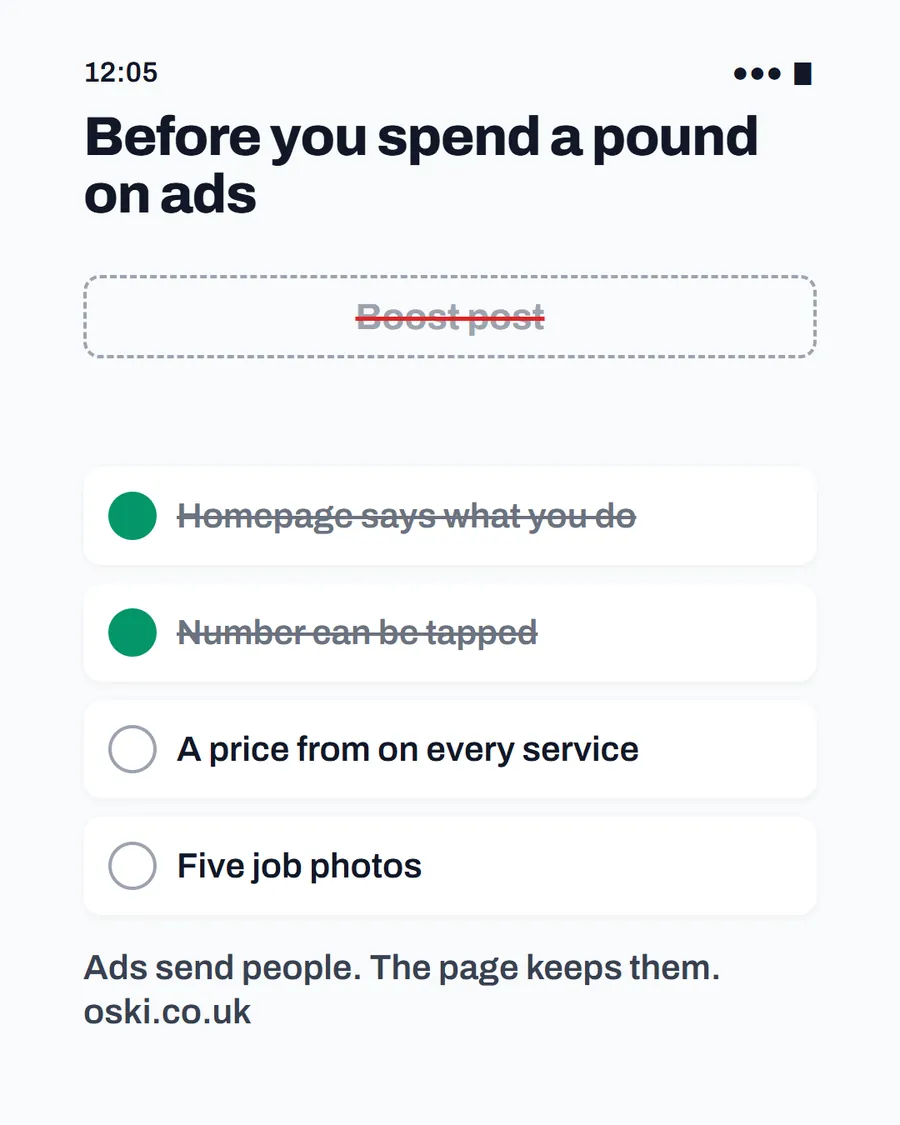
Before the first paid run, and whenever you change a claim, a price or an offer. It is also worth checking if you reuse an old ad, since details such as prices and deadlines go out of date. Build the check into your routine, as part of the steps in before you boost a post or run ads.
If you work with an agency, ask how they check ads for compliance. We make our ads inside the UK ad rules, and we are happy to explain how we do it.
How do you keep a record of your claims?
Keep a simple claims file: a spreadsheet or a folder with one line per claim. For each, note the claim as worded, the evidence you hold, where you keep it and the date you last checked it. A price list, a certificate, a screenshot of a review or a supplier's letter all count as evidence.
When an ad changes, update the file. If anyone ever asks you to back up a claim, you will find the proof in a minute, not a week. It also helps if you work with an agency, because everyone can see what has been checked.
What should you do if the advice says to change something?
Change it, then keep a copy of the advice and the new wording. If the advice is unclear, reply with a specific follow-up question rather than guessing. If you change the ad later, check again, because a small edit can alter a claim's meaning. Treat the advice as part of your normal publishing routine, not as a one-off.
What to do this week
- List every claim in your current ads, posts and leaflets, especially prices and "best" wording.
- Check each one against the evidence you hold, and remove any you cannot support.
- If you are unsure about a claim, prepare an enquiry using the five-point list above.
- Send it to the ASA's Copy Advice team, allowing three to five working days.
- If you would like us to check your ads against the UK rules first, send us a copy.
Frequently asked questions
Is ASA Copy Advice free?
The standard service is free, with a response time of three to five working days. The ASA also offers faster paid options, with a 48-hour, 24-hour and four-hour response, for advertisers who need an answer sooner.
Who can use ASA Copy Advice?
The ASA says it is for advertisers, agencies, media owners and media service providers checking non-broadcast ads against the CAP Code. A small business can use it for its own ads.
Does Copy Advice cover TV and radio ads?
No. It covers non-broadcast advertising, such as online ads, posters, leaflets and social media. TV and radio advertising goes through other routes, and the ASA's website explains where.
What should I send when I ask for advice?
The ad itself, where it will appear and the specific claims you want checked, along with any evidence you hold for them, such as prices, qualifications or customer reviews. The clearer your question, the more useful the answer.