How Long Should a Tradesperson's Quote Be? Why Two Pages Get Ignored
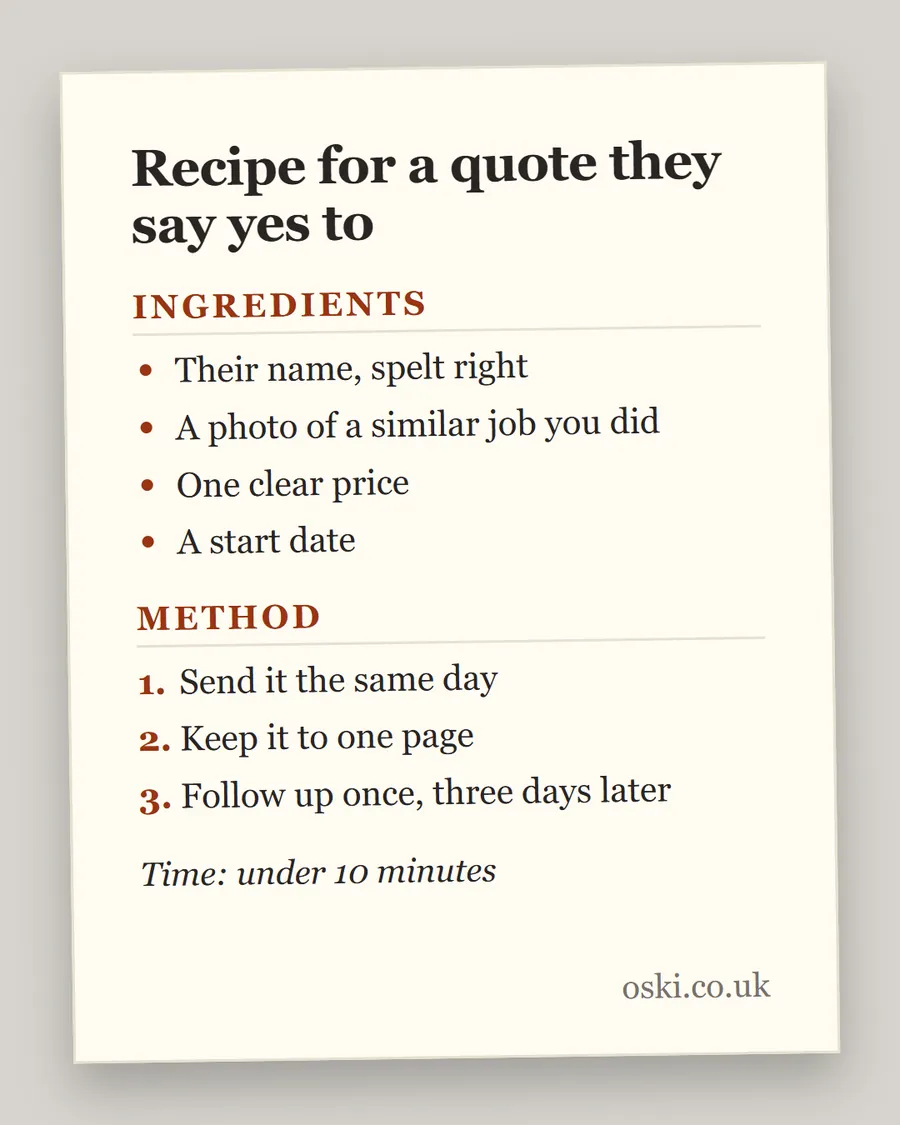
A tradesperson's quote should usually be one page: the customer's name, a short description of the work, one clear price, what is excluded, a start date and how long the quote is valid. Put the small print on a separate sheet. A quote that runs to two pages of dense text often goes unread, and the job goes to whoever made it easy.
The ad at a glance
| Question | Answer |
|---|---|
| Who it is for | Tradespeople who send detailed quotes and then hear nothing back. |
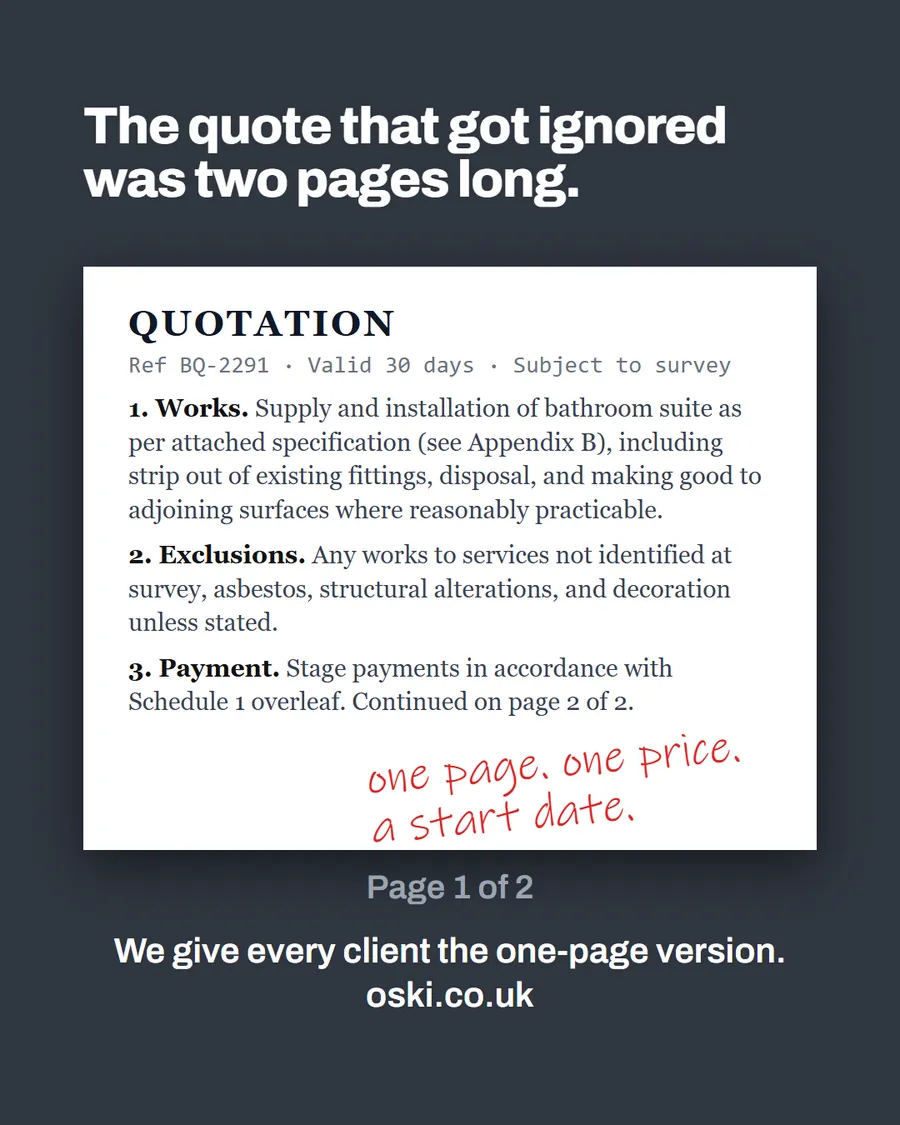
| What it shows | A PDF viewer showing page 1 of 2 of a dense quotation, with a handwritten red note saying "one page. one price. a start date.", under the headline "The quote that got ignored was two pages long." The quote is an example. |
| Where it applies | Across the UK, with a focus on London and the South East, where we are based. It is aimed at small local businesses wherever customers search for them. |
| Why we published it | A long quote is a common reason for silence, and the fix is within an owner's control. |
Why do two-page quotes get ignored?
Because the customer is comparing several, and the one they can understand in a minute is the one they act on. A page of terms before the price forces the reader to hunt for what they care about. Most people do not read small print before deciding. They look for the price, the start date and whether you sound trustworthy.
There is also a signal in length. A dense, jargon-heavy quote can look like a firm that is hiding something or that will be difficult to deal with. A short, clear quote looks like a firm that is confident in its work.
What belongs on page one?
Put the decision on the first page, in this order:
- The customer's name and address so it feels personal.
- A short description of the work. Two or three sentences in plain words.
- The price, as one figure or a clearly itemised total.
- What is excluded. The one or two things customers most often assume are included.
- The start date and how long the job should take.
- Validity. How long the quote is open for acceptance.
- How to accept. Reply to this message, sign below or ring.
If you can do that on one side of A4, you have a quote that gets read.
What can go on the second sheet?
Terms and conditions, detailed specifications, payment stages, warranty details and anything the customer will need if something goes wrong. Keep that sheet as short and readable as you can, and refer to it from page one: "Our terms are on the attached sheet." Anything that could genuinely surprise the customer, such as a fee for changes, should also appear in a single plain sentence on the first page.
If you are unsure what terms you need, get advice from a solicitor or a trade body, because requirements vary by trade and by customer type. This is not a substitute for that.
How should you show the price?
One figure is easiest. If the job has several parts, show them as a short table and a total, so the customer can see where the money goes.
| Item | Cost |
|---|---|
| Strip out and disposal | Shown |
| Supply and fit new fittings | Shown |
| Making good | Shown |
| Total | Shown |
Make sure the price you quote is the price the customer will pay, and say whether VAT is included where it applies. Our post on why customers pick the site with photos and a price explains why a clear price helps you win.
How do you make a quote easy to accept?
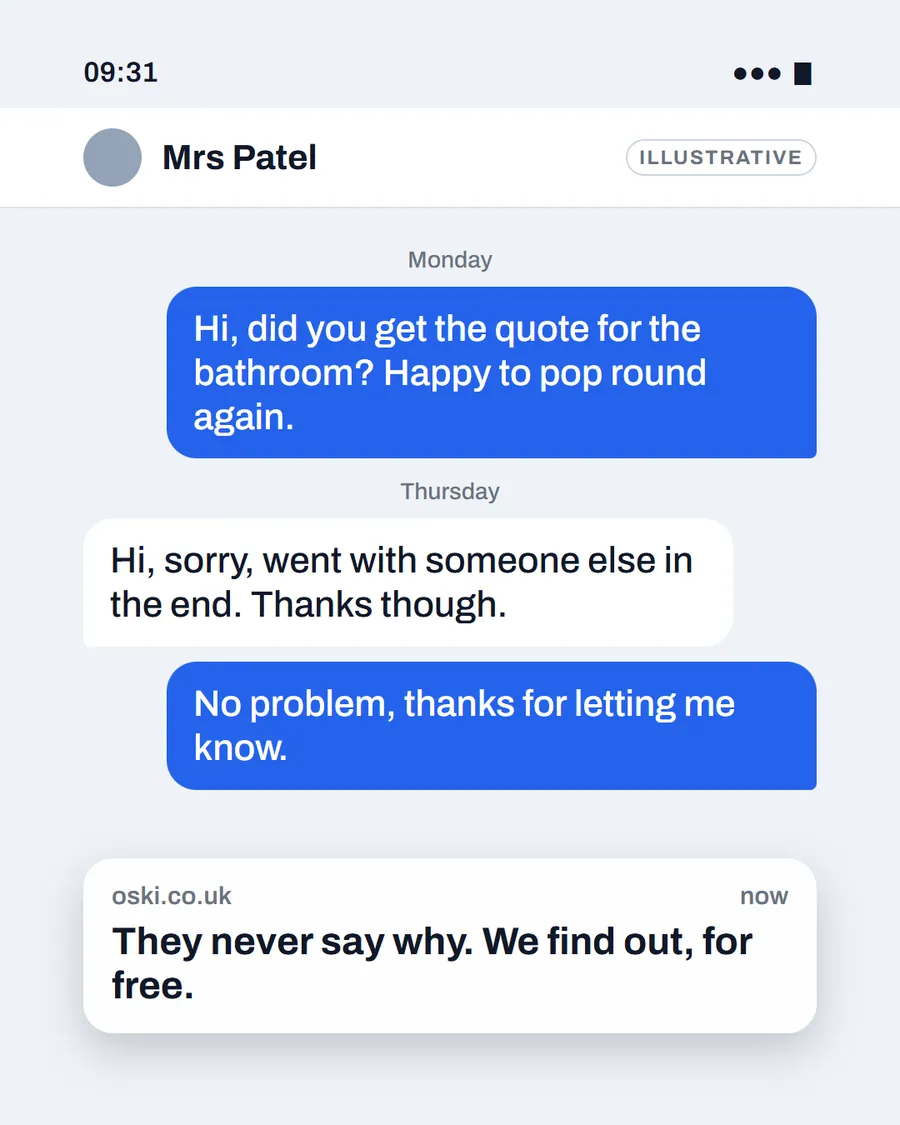
Give the customer one obvious next step. A button or a line such as "Reply YES and we will book your start date" is better than "Please contact us to discuss". Follow up once, a few days later, with a short message, and then leave it. If a customer says no, ask politely whether anything about the quote could have been clearer, as we describe in why customers say they went with someone else.
What mistakes should you avoid?
- Burying the price on page two.
- Using jargon the customer has to look up.
- Leaving out exclusions and then arguing about them later.
- Sending a quote with no start date, which gives the customer no reason to decide today.
- Quoting slowly. The quote that arrives first sets the benchmark for the others.
For a ready-made structure, see what goes in a quote template for tradespeople.
What about big jobs that need a longer document?
Larger projects do need more detail: a specification, a schedule of work, payment stages and a list of materials. That is fine. Keep the same principle by putting a one-page summary on top: the description, the total price, the start date and how long it is valid. The detailed specification then sits behind it as an appendix for anyone who wants to check.
A customer who has a one-page summary can decide quickly and share it with a partner or family member. The detail is there to protect both sides, but it should not stand between the customer and the decision.
Should a quote include photos?
Often, yes. A photo of the area you surveyed, with a note of what you will do, shows the customer you looked carefully and removes later disagreements about what was included. For a bigger job, add a photo of a similar finished project, with permission, so the customer can picture the result.
Keep photos small and labelled, and do not let them push the price to page two. One or two on the first page, or a clear link to a short gallery, is enough.
What to do this week
- Open your last three quotes and count the pages and the words before the price.
- Rewrite one so that page one has the description, price, exclusions, start date and validity.
- Move the terms to a separate sheet and refer to them from page one.
- Send the new version to your next customer and note the response.
- If you would like us to review a quote for clarity, send us a copy with the customer's details removed.
Frequently asked questions
How long should a quote be?
One page for most jobs, with the price, what is included, what is excluded and the start date at the top. Terms and conditions can sit on a separate sheet that you refer to, so the customer reads the important details first.
What should be on page one of a quote?
The customer's name, a short description of the work, one clear price, the main exclusions, a start date and how long the quote is valid. Everything a customer needs to say yes should fit on that first page.
Should a quote include terms and conditions?
Yes, but keep them readable and on a separate page or sheet. If a clause could surprise the customer, such as a call-out fee for variations, mention it plainly on page one as well.
How soon should I send a quote?
As soon as you reasonably can, ideally the same day as the visit. A customer who waits a week for a quote has often already decided, and the first useful quote tends to set the benchmark.