How to Ask a Customer for a Google Review: A Text You Can Copy
Ask for a Google review right after the job, while the customer is pleased, with a short message and your Google review link. Do not offer a discount or freebie, because Google prohibits it, and never write or buy reviews yourself, because fake reviews are banned in the UK. This is a general guide, not legal advice.
The ad at a glance
| Question | Answer |
|---|---|
| Who it is for | Tradespeople and local firms who have happy customers but few or old Google reviews, and feel awkward about asking. |
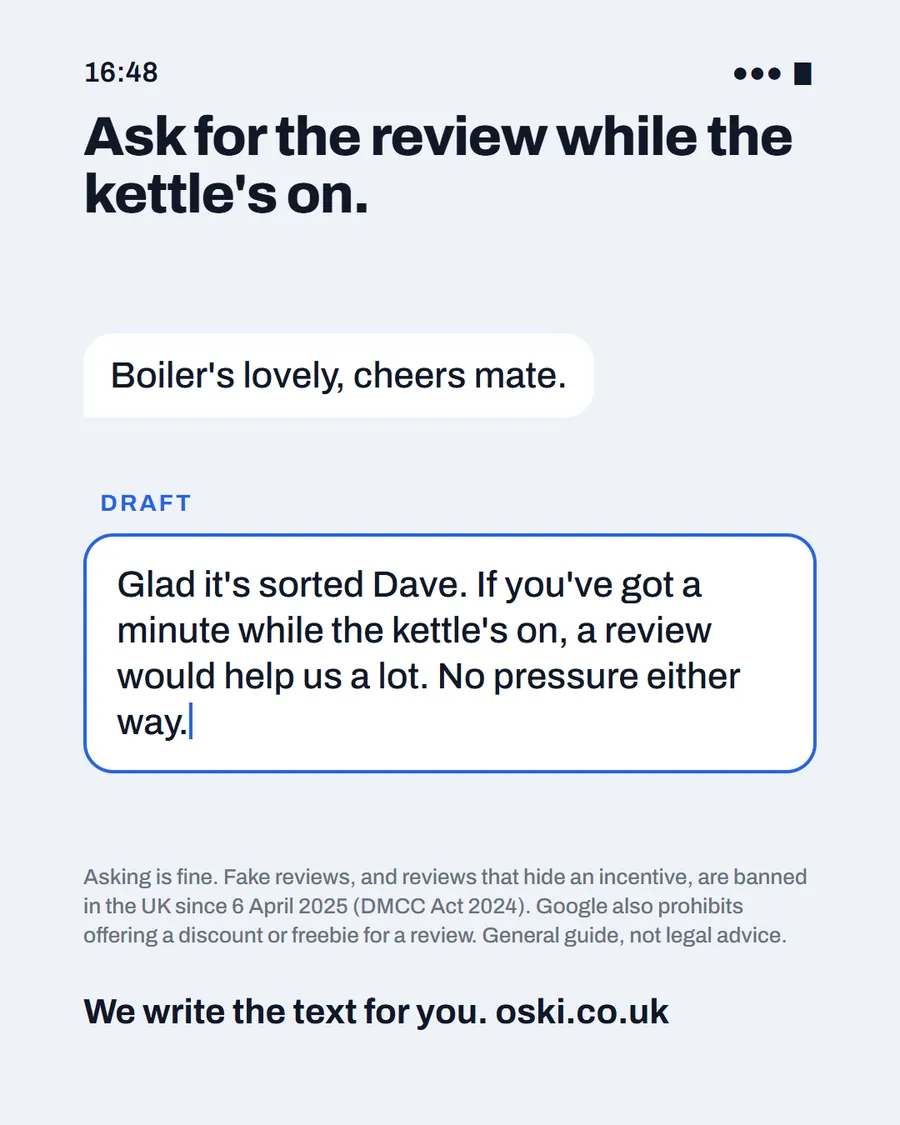
| What it shows | A text thread where a customer says "Boiler's lovely, cheers mate", and a drafted reply asking for a review "while the kettle's on", under the headline "Ask for the review while the kettle's on." A note in small print covers the UK rules. The people in it are illustrative. |
| Where it applies | Across the UK, with a focus on London and the South East, where we are based. It is aimed at small local businesses wherever customers search for them. |
| Why we published it | Owners avoid asking because they do not know the words. A ready-made text removes the excuse. |
When is the best time to ask?
At the end of the job, before you drive away, when the customer has just seen the finished work. A casual comment in person is the most natural: "If you are happy with it, a Google review would really help us. I will text you a link." Then send the message within an hour or two, while it is fresh.
If you wait a week, the customer has moved on and the request feels like admin. If you ask before the job is finished, it feels pushy. The end of the job, often with a cup of tea in hand, is the sweet spot. That is why the ad says "while the kettle's on".
What should the message say?
Keep it short, warm and easy to act on. Here is a text you can copy and adapt:
"Hi [name], glad the boiler is sorted. If you have a minute while the kettle is on, a Google review would help us a lot. Here is the link: [link]. No pressure either way. Thanks again."
For an email, add a subject line such as "A quick favour" and keep the same wording. For WhatsApp, the same text works. Always send it from your own number or business account so it feels personal.
How do you get your Google review link?
Google's help page on getting reviews says you can ask customers to visit a Google link or scan a QR code to leave a review, and it explains how to create them from your profile. Save the link on your phone so you can paste it into a message in seconds, and print the QR code on a card or invoice if you meet customers in person.
Test the link on your own phone before you send it to anyone. It should open the review box for the right business, not a search page.
What must you never do?
This is where owners go wrong, usually without meaning to.
| Do not | Why |
|---|---|
| Offer a discount or freebie for a review | Google says offering free or discounted goods or services in exchange for reviews is strictly prohibited |
| Write a review of your own business | The CMA's guidance says fake reviews are banned |
| Ask a friend or relative who has not used you to post one | It is a fake review under the same guidance |
| Pay a company to post reviews | It is likely to be a banned practice and can get your profile penalised |
| Offer something to remove a bad review | Google prohibits incentives to change or remove reviews |
The CMA's guidance on fake reviews explains that the banned practice covers fake reviews and reviews that conceal an incentive, and that it came into force on 6 April 2025. It also says a review is not fake just because the trader dislikes it, as long as it reflects the reviewer's genuine experience.
Is a review request marketing under the rules?
It can be, depending on the message. The ICO's guidance on identifying direct marketing says a message that includes promotion counts as direct marketing even if that is not its main purpose, and that phrasing, tone and context are likely to be key factors. In practice, keep the request plain: ask for the review, give the link and leave out any offer or advert for other services. If you are unsure, check the ICO's guidance for your situation.
What should you do after the review arrives?
Reply to every review, usually within a day or two. For a good one, a short thank-you that mentions the job works well. For a poor one, stay calm and factual, and offer to put it right; our guide on replying to negative reviews shows how. Replies are read by future customers, so they are part of your marketing.
For a longer plan on building up your review count steadily, read how to get more Google reviews.
How many reviews should you aim for?
There is no magic number. Aim for a steady trickle: one or two a month is a healthy rhythm for most small firms, and it keeps the newest review recent. Customers care more that the latest review is from this season than that you have hundreds. Google's Business Profile help encourages valuing all reviews, so welcome the honest ones, including the mixed ones.
What to do this week
- Create your Google review link and save it on your phone.
- Copy the text above and edit it to sound like you.
- Send it to your last five happy customers.
- Reply to any reviews you have not answered yet.
- If you would like us to set up a simple review routine for your business, send us a message.
Frequently asked questions
Is it allowed to ask customers for Google reviews?
Yes. Google says you can ask customers to visit a Google link or scan a QR code to leave a review. What is not allowed is offering free or discounted goods or services in exchange for reviews, which Google describes as strictly prohibited.
When is the best time to ask for a review?
Straight after the job, while the customer is pleased and the work is fresh. Ask in person first if you can, then send a short follow-up message with the link.
Can I only ask my happiest customers?
It is better to ask everyone you have done work for. Selecting only people you expect to be positive makes your reviews less representative and can look misleading if it becomes obvious. Reply to every review, good or bad.
Are fake reviews illegal in the UK?
Fake reviews, and reviews that hide the fact they were incentivised, have been banned in the UK since 6 April 2025 under the DMCC Act 2024. Never write a review for your own business or ask someone to write one they have not earned.