What Should a Monthly Marketing Report Include? A One-Page Template
A monthly marketing report for a small business should fit on one page and answer four questions: what was done, what it cost, what came in and what happens next. If it cannot, it is too long or too vague. Use figures that link to enquiries, such as calls and direction requests, not only impressions.
The ad at a glance
| Question | Answer |
|---|---|
| Who it is for | Business owners paying an agency or freelancer who receive either nothing or a pile of charts. |
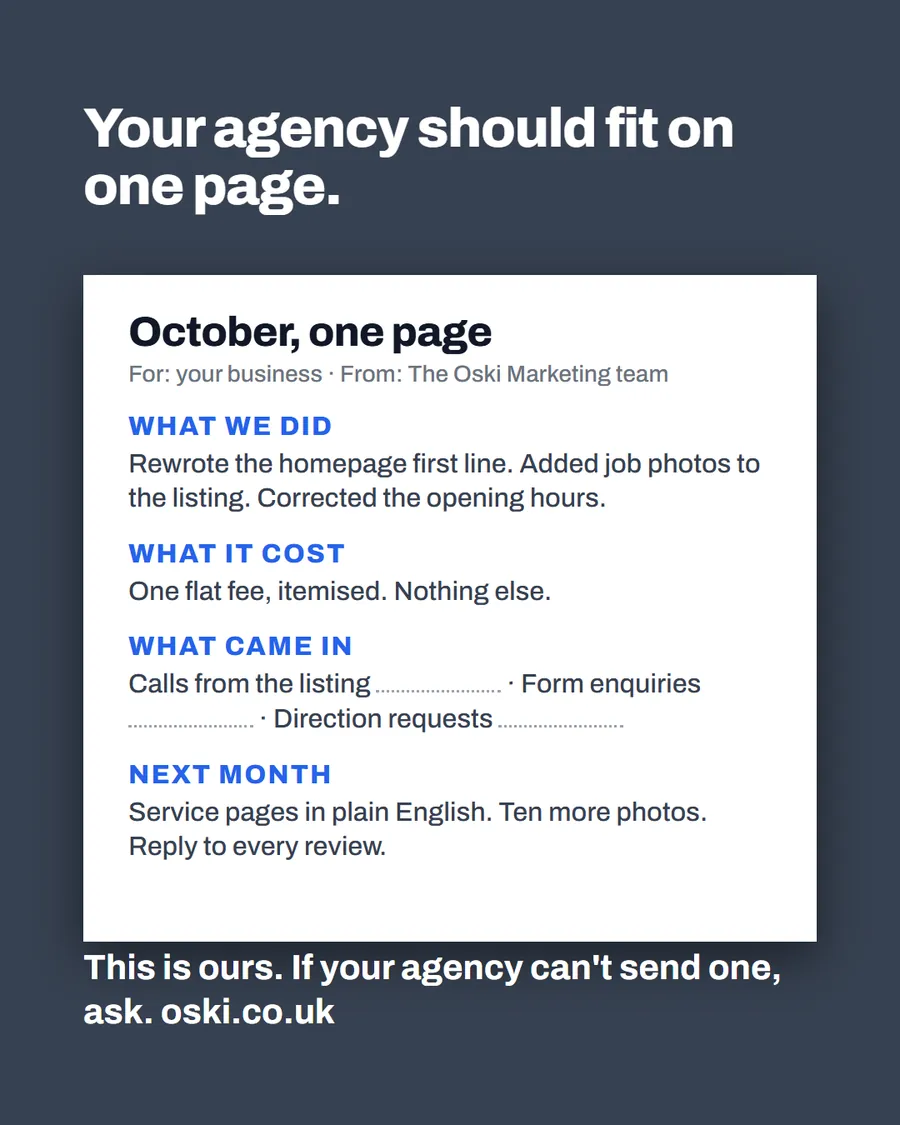
| What it shows | A one-page report document titled "October, one page" with sections for what we did, what it cost, what came in and next month, with blanks where results go, under the headline "Your agency should fit on one page." The report is a template. |
| Where it applies | Across the UK, with a focus on London and the South East, where we are based. It is aimed at small local businesses wherever customers search for them. |
| Why we published it | Owners often do not know what to ask for. Showing the format makes the standard clear, whoever they work with. |
Why does a report need to be one page?
Because a report is for decisions. An owner has to decide whether to continue, change direction or spend more, and a clear one-page summary makes that possible. A long document full of graphs invites the reader to skim, miss the point and stay in the dark.
One page also keeps the agency honest. It is hard to hide a lack of progress on a single sheet. If a month's work was small, the page shows it, and a good agency will say so and explain why.
What are the four sections?
Each has a plain-English job.
- What we did. A short list of the actual work: pages rewritten, photos added, hours corrected, ads made.
- What it cost. The fee and any ad spend, itemised, with nothing hidden.
- What came in. Enquiries, calls and any other results, in numbers you can check.
- Next month. The two or three things planned, and why.
Anything beyond that is extra. If a chart helps explain a point, include it. If it is there to look impressive, leave it out.
Which numbers belong under "what came in"?
Choose figures that relate to real customers. For a small trade business with a Google listing, Google's performance help page explains that a verified profile can show calls, directions requests and website clicks, as well as how many people viewed the profile on Search and Maps and the search terms they used.
| Measure | What it tells you |
|---|---|
| Calls from the listing | People who tapped to ring you |
| Directions requests | People planning to visit or looking for your address |
| Website clicks | People who wanted to learn more |
| Form enquiries | People who contacted you through the website |
| Jobs booked | The ones that became work, which only you can count |
The last row matters most, and it needs your input. Keep a simple log of where each new job came from, and share it with whoever prepares the report.
What should you ignore or treat with care?
Some figures look good and mean little on their own. Impressions, followers and likes show attention, not work. A ranking is context, not the aim. Be cautious about any report that is mostly these figures, and ask: "How many enquiries did this bring in?" If the answer is vague, say that you want that number next month.
Equally, be honest about uncertainty. Some enquiries cannot be traced, such as a customer who sees your van and later rings. A good report says so instead of pretending everything is measurable.
What does a good one-page template look like?
Here is a simple structure you can copy.
| Section | Content |
|---|---|
| Header | Month, business name, who prepared it |
| What we did | Three to six bullet points |
| What it cost | Fee, ad spend, any extras |
| What came in | Calls, directions, website clicks, form enquiries, jobs booked |
| Notes | Anything unusual, such as holidays or a closed week |
| Next month | Two or three planned actions and why |
A report like this takes minutes to read and gives you something to compare month to month. Our post on what to do when you cannot see what an agency does explains how to ask for it.
What if your agency does not send a report?
Ask for one, politely, with the template above. A good agency will be glad to; clear reporting helps them show their value. If they push back or send only dashboards with no explanation, it is worth reading our list of marketing agency red flags and the questions to ask when choosing an agency. A one-page report is a reasonable thing to expect from anyone you pay.
How do you read the report without being an expert?
Read it in the order you would explain it to a friend. First, what was done: does it match what was agreed? Second, what it cost: does it match the invoice? Third, what came in: is it more, less or the same as last month, and does the report say why? Fourth, what is planned: does it make sense given the first three?
If something is missing or confusing, ask a plain question: "What does this number mean, and what would you expect it to be next month?" A good agency welcomes that kind of question, and the answer tells you a lot about how they think.
How often should you review it?
Monthly is right for most small businesses, with a longer review every quarter. In the monthly read, you are looking for problems and obvious progress. In the quarterly review, step back and ask whether the work is moving the numbers that matter, such as calls and jobs, and whether the agreed plan still makes sense for the business.
Put the review in your diary, ideally for the same time each month. A report you do not read is wasted effort on both sides, however good the template.
What to do this week
- Copy the six-section template above into a document.
- Fill it in for last month yourself: what was done, what it cost, what came in.
- Open your Google Business Profile performance report and note calls, directions and website clicks.
- If you work with an agency, send them the template and ask for the next report in that format.
- If you would like us to set up a one-page report for your business, send us a message.
Frequently asked questions
What should be in a monthly marketing report?
What was done, what it cost, what came in and what happens next. If a report cannot answer those four things on one page, it is probably too long or too vague to be useful.
How long should a marketing report be?
One page for a small business. Detail can sit in an appendix for anyone who wants it, but the headline should be readable in a minute. A report that needs a meeting to explain is not doing its job.
What numbers matter in a Google Business Profile report?
Google's performance report shows calls, directions requests and website clicks, plus profile views on Search and Maps and the search terms people used. Calls, directions and website clicks are closest to real enquiries.
Should an agency report on rankings?
Rankings can be useful context, but they should not be the headline. A page-one position that brings no calls helps nobody, so ask what came in as well. Be wary of reports that show only impressions and rankings.