Paying a Marketing Agency and Can't See What They Do? What to Ask For
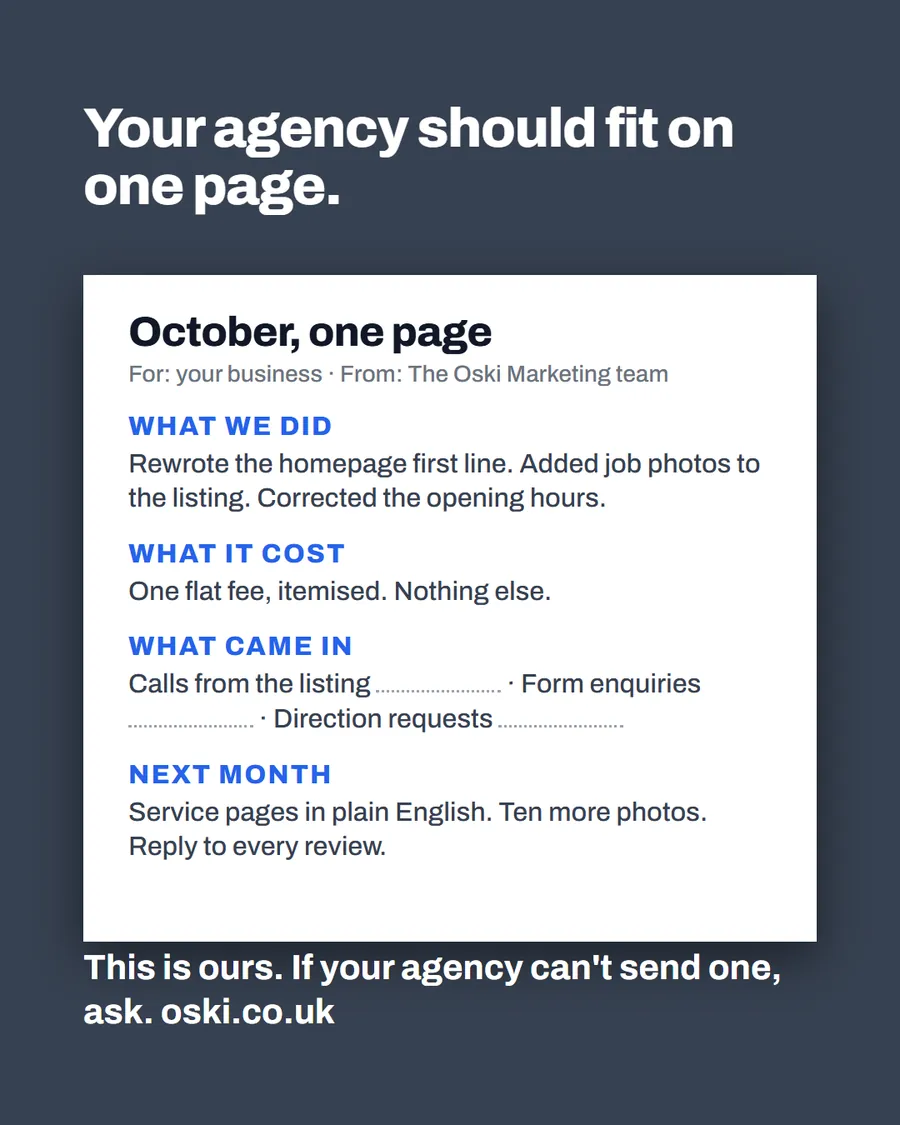
If you pay a marketing agency every month and cannot tell what it does, ask for one page: what was done, what it cost and what came in. A good agency will send it without fuss. If it cannot or will not, you have learned something important, and you can decide what to do about the arrangement.
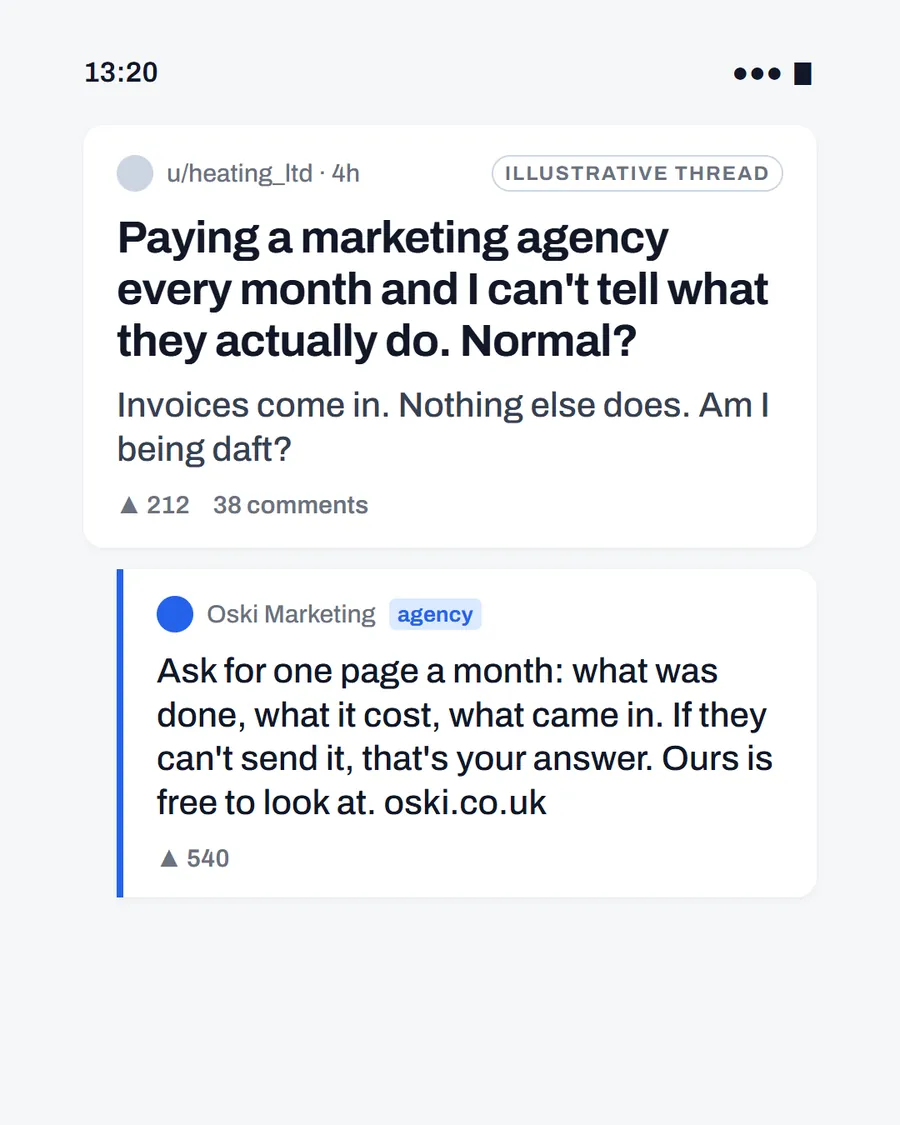
The ad at a glance
| Question | Answer |
|---|---|
| Who it is for | Business owners paying a monthly fee to an agency or freelancer and receiving invoices but little else. |
| What it shows | A forum thread where a post asks "Paying a marketing agency every month and I can't tell what they actually do. Normal?" with a labelled reply from Oski Marketing: ask for one page a month, what was done, what it cost, what came in. The post and thread are illustrative. |
| Where it applies | Across the UK, with a focus on London and the South East, where we are based. It is aimed at small local businesses wherever customers search for them. |
| Why we published it | It is a question owners ask in private and rarely get a straight answer to. We would rather say plainly what a fair arrangement looks like. |
Why does this happen?
A few reasons, and none of them requires bad intent. Some agencies work in a way that is hard to see, such as technical changes behind the scenes. Some send reports full of numbers that look busy but say little. Some are simply stretched, and reporting is the first thing to slip. And some, frankly, are doing little, and a vague report hides it.
From the owner's side, there is also a reason: you are busy, the invoice gets paid and nobody asks. After a few months, you are paying for something you cannot describe. The fix is to ask for what you should have had from the start.
What should you be able to see every month?
Four things, on one page.
| Section | What it should say |
|---|---|
| What was done | The specific work, in plain words |
| What it cost | The fee, ad spend and any extras |
| What came in | Calls, enquiries, direction requests, jobs |
| What is next | Two or three planned actions and why |
We describe a full template in what a monthly marketing report should include. If you receive something close to that every month, you are in a good position. If you receive only charts, or nothing at all, ask.
How do you ask without causing a row?
Be direct and friendly. Something like:
"I would like to understand what we are getting each month. Could you send me a one-page summary: what you did, what it cost and what came in? A simple format is fine."
Send it by email so there is a record. A good agency will take it as a sign you care, and will welcome the chance to show its work. If the reply is defensive or vague, note that, and ask again in plain terms.
Which questions help you understand the work?
Choose a few that matter to you.
- What exactly did you change on my website or listing this month?
- Can you show me before and after?
- How many calls, forms and direction requests came from it?
- How do you know where each enquiry came from?
- What would you do differently if the results do not improve?
- Who owns my accounts, and where are the logins?
You do not need to understand the technical side. You need to be able to describe, in a sentence, what you are paying for.
What are the warning signs?
Be wary if you notice any of these.
- Reports with impressions and rankings but no enquiries. They show activity, not results.
- Promises of rankings or lead numbers. Nobody can guarantee them.
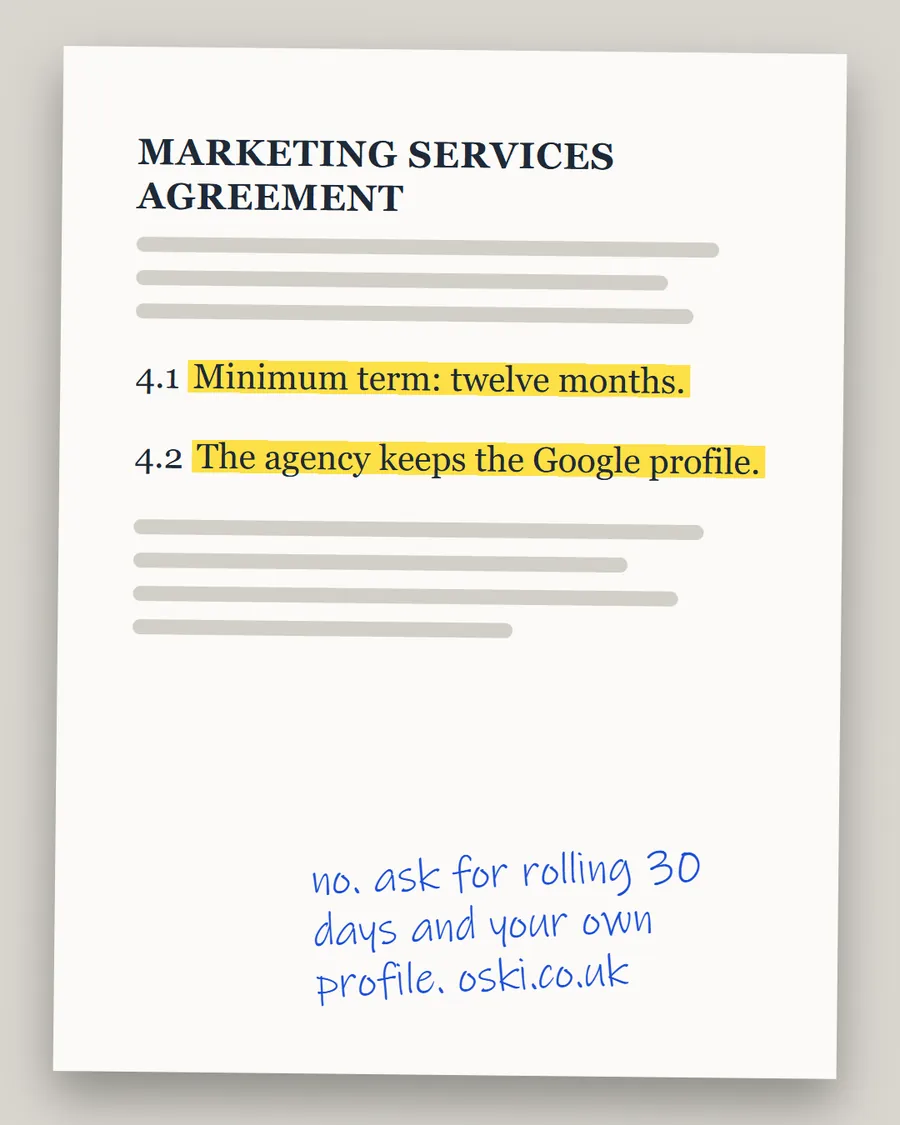
- Reluctance to say who owns the accounts. You should own your domain and Google profile.
- A long minimum term with little to show. Read the agreement and the notice period.
- No named person to speak to. You should know who is doing the work.
Our list of marketing agency red flags covers more, and minimum terms and profile ownership explains the two clauses that cause the most regret.
What if you decide to leave?
Start by reading your agreement for the term and the notice period. Then check who owns your website, domain and Google Business Profile, and ask in writing for logins and files. Do this calmly and early, because things are easier while the relationship is still working.
If you want to dispute payment or think a term is unfair, speak to a solicitor or advice service before withholding anything, because it depends on your contract. This is a general guide, not legal advice. Once you are free, you can choose a new provider, or take on part of the work yourself.
How do we handle this?
For clarity, here is how we work. Our retainers run on rolling contracts with no lock-in. You get a plain-English report, and you own your website, your domain and your Google Business Profile, with us holding manager access only. We do not promise rankings or lead numbers. You can hold us to that, or compare it with any agreement you are offered.
What to do this week
- Send your agency the one-page request above.
- Check who owns your Google Business Profile, domain and website.
- Find your agreement and note the term and notice period.
- Write down, in one sentence, what you believe you are paying for.
- If you would like a second opinion on what you are getting, send us your latest report or invoice.
Frequently asked questions
Is it normal not to know what my marketing agency does?
It happens often enough to be worth naming, but it is not acceptable. You pay for the work, so you should be able to see what was done, what it cost and what came in each month, in plain English.
What should a marketing agency send me every month?
A short report covering what they did, what it cost, what enquiries or results came in and what they plan next. One page is enough for a small business.
What if the agency says the work is technical?
Ask them to explain it in plain words, and to show the result on your website or listing. Good agencies can describe technical work simply. If they cannot, that tells you something.
How do I leave an agency I am not happy with?
Read your agreement for the term and notice period, check you own your website, domain and Google profile, and ask for logins and files in writing. Seek advice before withholding payment, because it depends on your contract.