
What Does Marketing for a Local Business Actually Include? Five Things
Marketing for a local business comes down to five things: real photos of your jobs, a price on the page, reviews you asked for, a homepage written in plain English and ads that look like you. Do them well, in that order of ease, and you have covered most of what customers look at before they ring.
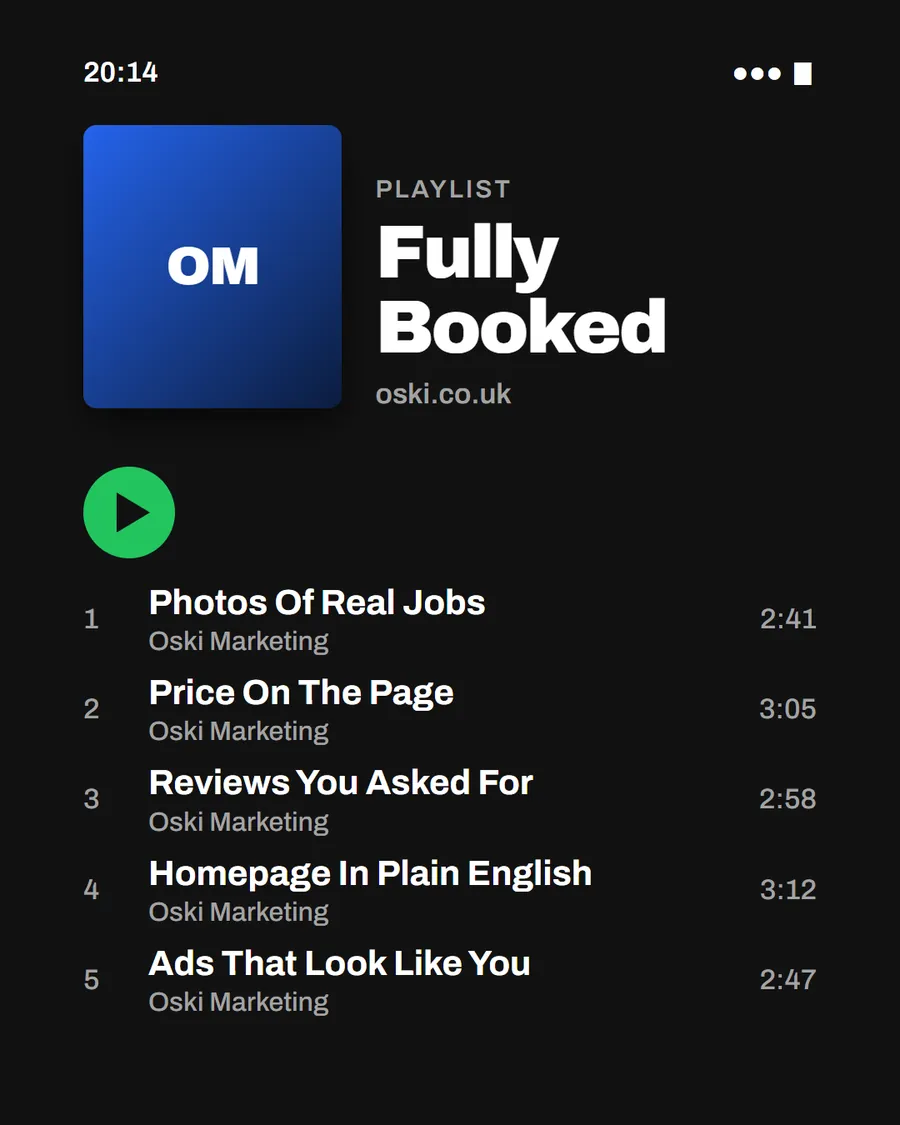
The ad at a glance
| Question | Answer |
|---|---|
| Who it is for | Owners who hear "marketing" and are unsure what it actually involves, or who feel overwhelmed by the options. |
| What it shows | A dark music-app playlist screen titled "Fully Booked" with five tracks: Photos Of Real Jobs, Price On The Page, Reviews You Asked For, Homepage In Plain English and Ads That Look Like You, each credited to Oski Marketing. |
| Where it applies | Across the UK, with a focus on London and the South East, where we are based. It is aimed at small local businesses wherever customers search for them. |
| Why we published it | A playlist is a list you can scan and remember. It turns a vague word into five concrete jobs. |
Why a playlist?
Because most people do not need a strategy document. They need a short list they can recall and act on. Five tracks on a playlist is easy to hold in your head, and each one is something you can start this week. It also makes the point that marketing is a set of small, repeatable pieces, played in order, not one big thing.
The title, "Fully Booked", is the aim: a business busy enough that it is turning work away. We make no promise that any of this gets you there, because it depends on many things, but each track moves you in that direction.
Track one: photos of real jobs
Proof that you can do the work. A handful of clear, recent photos of finished jobs on your Google listing, your homepage and your social profiles. This is the cheapest and quickest improvement for most trades, and the one customers notice first. Our guide to using photos of your work shows how to pick and place them.
Track two: a price on the page
A starting price, or a clear explanation of how you quote, so customers know roughly what to expect. It removes the fear of an unexpected bill and filters out people who are not a fit. Make sure any "from" price is accurate and not misleading, as we explain in why customers pick the site with photos and a price.
Track three: reviews you asked for
Recent, genuine reviews, collected by asking every satisfied customer and replying to each one. They show that other people were happy, and they are one part of how Google judges how well known a business is. Never offer something in return and never write your own. Our template in how to ask for a Google review shows what to say.
Track four: a homepage in plain English
The first screen says what you do and where, with a real photo, one proof point and a tappable number. No "Welcome", no jargon. This is where most of the effort of a rewrite goes, and where our homepage mark-up starts. If you do only one thing on your site, do this.
Track five: ads that look like you
Ads and posts made from your real work, in a style that fits the place people see them. A text thread, a notes page, a photo of a finished job with a short caption. They should look like content, not like an advert, and every claim in them should be true and provable. If you pay to promote them, fix the page first, as in before you boost a post or run ads.
What sits underneath the five?
A few foundations make all five work: a Google Business Profile that is complete and accurate, a phone that is answered, a contact form that reaches you and a simple way to see where enquiries come from. Our funnel guide explains how the stages connect, and online presence quick wins lists fast fixes.
| Foundation | What to check |
|---|---|
| Google listing | Photos, hours, services, reviews |
| Contact routes | Phone, form and messages all answered |
| Tracking | A way to know where jobs came from |
| Ownership | You own your domain, site and profile |
What should you do yourself, and what is worth paying for?
You can do a lot yourself: take photos, ask for reviews, reply to them, post a finished job each week. Where paid help makes sense is where skill or time is the limit: rewriting a homepage in plain English, making finished ads, setting up tracking, or checking claims against the advertising rules.
When you do pay, ask for the scope itemised, a short report each month and rolling terms. Our guide to what digital marketing costs in the UK explains what to expect.
How do the five fit together?
They build on each other. Photos and a clear homepage give customers a reason to trust you. A price lets them decide. Reviews show that others agree. Ads and posts then carry all of it to people who have not heard of you yet. If you start with ads and skip the first four, you pay to send people to a page that does not convince them.
That is why we suggest working roughly in order: fix what customers see when they arrive, then add proof, then promote. Each step makes the next one work harder.
How long does it take to see a difference?
It depends on the piece. Photos, a first line and a price can change how customers react as soon as they are live. Reviews build over weeks and months, one customer at a time. Search visibility moves slowly and cannot be promised. Ads can bring clicks quickly, but whether they bring jobs depends on the page and your reply speed.
Be wary of anyone who promises quick, certain results. A steady, honest approach tends to build something that lasts, and you can judge it by the enquiries you receive.
What to do this week
- Rate yourself one to five on each of the five tracks.
- Pick the lowest and write down one action that would improve it.
- Do that action within the week.
- Add a second track next month.
- If you want us to score your business on the five, send us your web address and business name.
Frequently asked questions
What does marketing for a local business include?
At its simplest: real photos of your work, a price or clear way to quote, reviews you have asked for, a homepage in plain English and ads or posts that look like your business. Everything else supports those five.
Do I need all five at once?
No. Start with the cheapest and quickest, usually photos and the homepage, then add the rest over a few months. Doing two well beats doing five badly.
Which should I do first?
The one where you are weakest and the fix is fastest. For most small firms that is the homepage first line and the photos on the Google listing, which can both be done in a week.
How much does local marketing cost?
It varies widely with what you need and who does it. Some of it, such as photos and replies to reviews, you can do yourself. For paid help, compare what is included and whether the contract has a minimum term.