What Makes a Customer Choose Your Business Online? Photos, a Price and Being Easy to Find
A customer chooses your business when three things overlap: real photos that prove the work, a price or starting price that removes the fear, and being easy to find in local results. Miss one and you give them a reason to look elsewhere. Score yourself on all three and fix the weakest first.
The ad at a glance
| Question | Answer |
|---|---|
| Who it is for | Owners who want a simple framework for what to improve first, instead of a long list. |
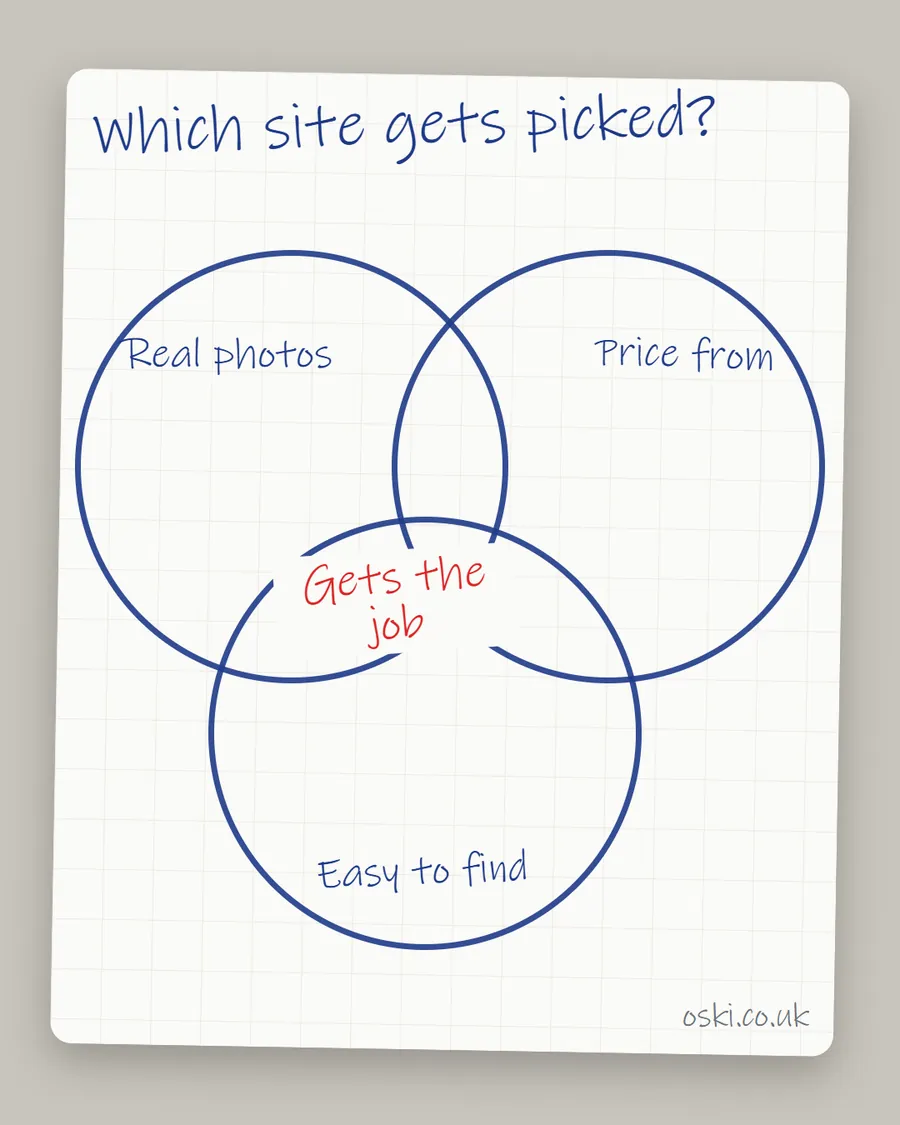
| What it shows | A hand-drawn Venn diagram on a napkin with three circles labelled "Real photos", "Price from" and "Easy to find", overlapping at "Gets the job", under the headline "Which site gets picked?" |
| Where it applies | Across the UK, with a focus on London and the South East, where we are based. It is aimed at small local businesses wherever customers search for them. |
| Why we published it | A drawing on a napkin is how an owner might explain it to a friend. It shows that the answer is simple, and that all three parts matter together. |
Why three circles and not one?
Because each circle answers a different question, and a customer needs all three answered. Photos answer "can they do the work?". A price answers "what will it cost, roughly?". Being easy to find answers "can I reach them, and are they real?". If one is missing, the customer cannot complete the decision, and they move on to a firm that lets them.
Many owners focus on one circle only. A firm with great photos that nobody can find loses to a visible firm with weaker work. A firm that is easy to find but shows no price loses to the one that does. The overlap is where you win.
How do you score the first circle, real photos?
Count and judge. Open your Google listing and your homepage, and ask:
- Are there at least five photos of finished work?
- Are they your own, in focus and well lit?
- Is the newest one from the last few weeks?
Google's photo guidance asks for photos that are in focus and well lit, without excessive filters, and says images should represent reality. If you answer no to any question, start here. Our guide to using photos of your work shows how.
How do you score the second circle, a price from?
Look for a number or a clear explanation on your homepage and service pages. Can a customer tell, within a few seconds, roughly what a common job costs or how you quote? If every price is "contact us", you are in the weak part of this circle.
Add a starting price for your most common job, and say what it includes. If prices vary too much, explain how you work: a free survey, a fixed call-out fee, a day rate. Keep it accurate. Our post on why customers pick a site with photos and a price explains the advertising rules on "from" prices.
How do you score the third circle, easy to find?
This one has the most moving parts. Check:
| Test | What to look for |
|---|---|
| Search your trade and town | Do you appear, and where? |
| Your Google listing | Complete, accurate and active? |
| Your website | Does it name your trade and area in plain text? |
| Your details elsewhere | Same name, address and phone number everywhere? |
| Your reviews | Recent and replied to? |
Google says local results are mainly based on relevance, distance and prominence, and that complete and accurate information makes a business more likely to show up, in its local ranking help page. You cannot change distance, but you can improve the other two. Our Business Profile checklist and local SEO strategies go deeper.
What does a business that wins all three look like?
Take two example plumbers in the same town. The first has a Google listing with five job photos, a clear services list and recent reviews. Their website says "Plumbing and heating in Croydon", shows two finished bathrooms and a call-out fee, and has a tappable number. The second has a thin listing, an old website with stock images and no price. A customer who compares them for a minute will choose the first, whatever the actual difference in skill.
That is the whole idea of the napkin sketch. The winner is not always the best tradesperson. It is the one who makes the decision easy.
What should you fix first?
Start with the lowest score. If you cannot be found, fix the listing and the town wording first. If people find you but leave, fix the photos and the price. If you are weak in all three, begin with the quickest: photos can go up in an afternoon, a starting price in an hour, and the town in a few minutes.
Do one thing at a time and give each a couple of weeks. That way you can see what changes, and you avoid the exhaustion of trying to do everything at once.
How do you check yourself against competitors?
Search for your trade and town on your phone and open the top three results, then give each of them the same three scores: photos, price and ease of finding. Write the scores down. Where a competitor scores higher than you, look at what exactly they do. It might be five clear photos, a stated call-out fee or a listing full of recent reviews.
Copy the idea, not the wording. Your photos, your price and your description should be your own. The aim is to match them where they are ahead, and beat them where you can, such as with faster replies or a clearer first line.
How long before you see a difference?
Photos and a price can change how a customer reacts as soon as they are live, so you may notice more calls within days. Being easier to find takes longer, because it builds through reviews, consistent listings and time. Do not be discouraged if search positions move slowly, and be wary of anyone who promises quick results.
What to do this week
- Score yourself from one to five on each of the three circles.
- Pick the lowest and write down the single action that would move it up.
- Do that action within the week.
- Ask a friend to search your trade and town and tell you what they notice.
- If you want us to score your business for you, send us your web address and business name.
Frequently asked questions
What makes a customer choose one local business over another?
Usually three things overlap: proof of the work, a sense of the cost and how easy the business is to find and contact. A firm that scores on all three tends to get the call, while one that misses any of them gives the customer a reason to look elsewhere.
What does 'easy to find' mean for a small business?
Appearing in local search results for your trade and town, with a complete Google listing, a website that names your area and consistent details everywhere. Google says local results depend on relevance, distance and prominence.
Which of the three matters most?
It depends on your starting point. If nobody finds you, being easy to find comes first. If people find you and leave, photos and price are usually the fix. Score yourself on each and start with the weakest.
How long does it take to improve all three?
Photos and a price can be added in a week. Being easy to find builds over weeks and months, because reviews and consistent listings accumulate. Start with the quick wins and keep adding.