The Read-It-Out-Loud Test: Is Your Homepage Putting Customers Off?
Read your homepage out loud and record it on your phone. If you stumble, get bored or hear words you would never say to a customer, the page needs rewriting. Cut every sentence that does not say what you do, where, why to trust you or how to get in touch, and write it as you would speak to someone on the phone.
The ad at a glance
| Question | Answer |
|---|---|
| Who it is for | Owners whose website was written in a hurry, by a template or by someone who does not know the trade. |
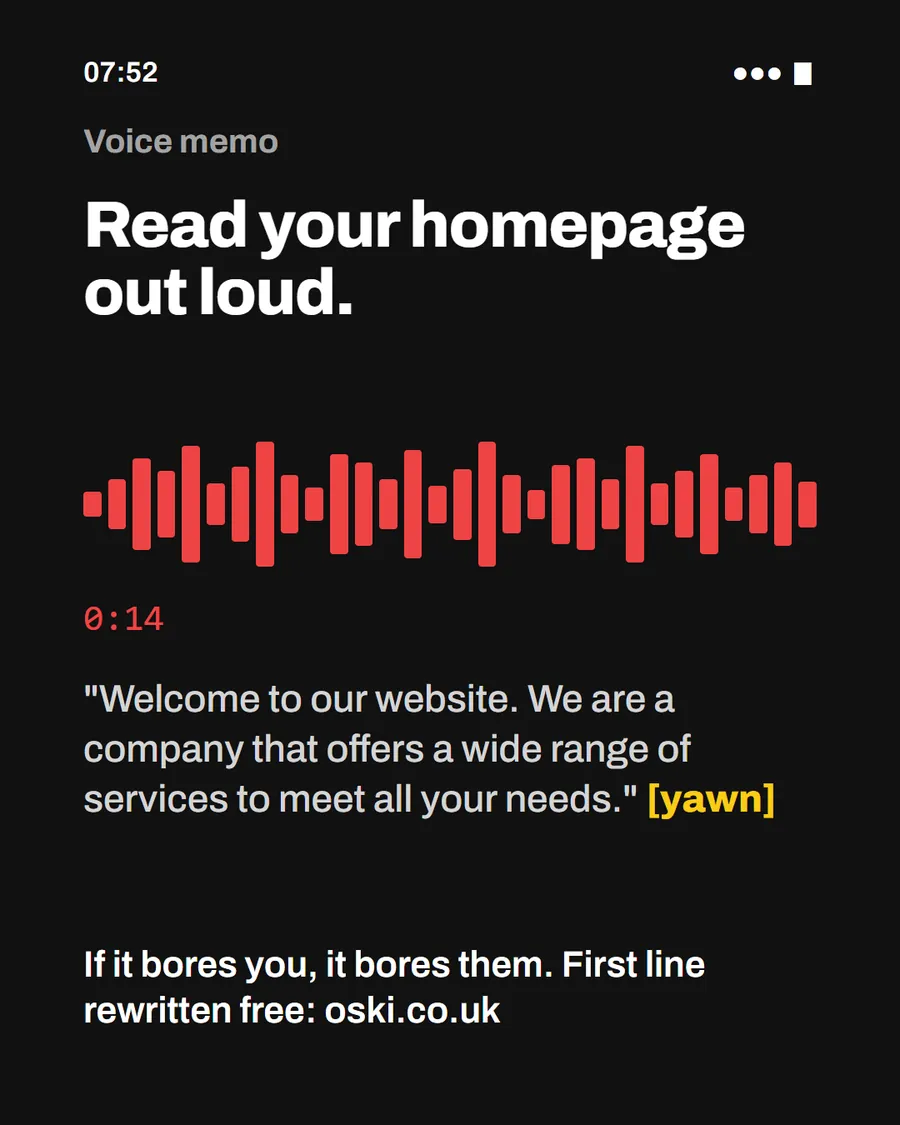
| What it shows | A voice memo screen with a red sound wave and a transcript of a typical homepage opening, "Welcome to our website. We are a company that offers a wide range of services to meet all your needs", marked with a yawn, under the headline "Read your homepage out loud." |
| Where it applies | Across the UK, with a focus on London and the South East, where we are based. It is aimed at small local businesses wherever customers search for them. |
| Why we published it | It is a test anyone can do with no tools, and the result is usually obvious within a sentence. |
Why does reading aloud work?
Because your ear catches what your eye misses. On the screen, a sentence like "We are a company that offers a wide range of services to meet all your needs" looks professional. Out loud, it sounds like nothing. It tells you nothing about what the company does, and nobody would say it to a customer.
Spoken language is built for a listener who has to follow in real time, so it is short, concrete and direct. Good web copy for a small business should be the same. If you would not say it across a counter, do not put it on the page.
How do you run the test?
It takes two minutes:
- Open your homepage on your phone.
- Start a voice recording.
- Read the first screen aloud, exactly as written.
- Stop and listen back.
- Mark every place where you stumbled, sighed or lost interest.
Do it again with a friend who does not know the business, and ask them one question afterwards: "What do you think we do, and where?" If they cannot answer in a sentence, customers will not either.
What phrases fail the test?
Certain phrases show up on many small business sites. They are hard to say out loud, and they say little.
| Instead of | Try |
|---|---|
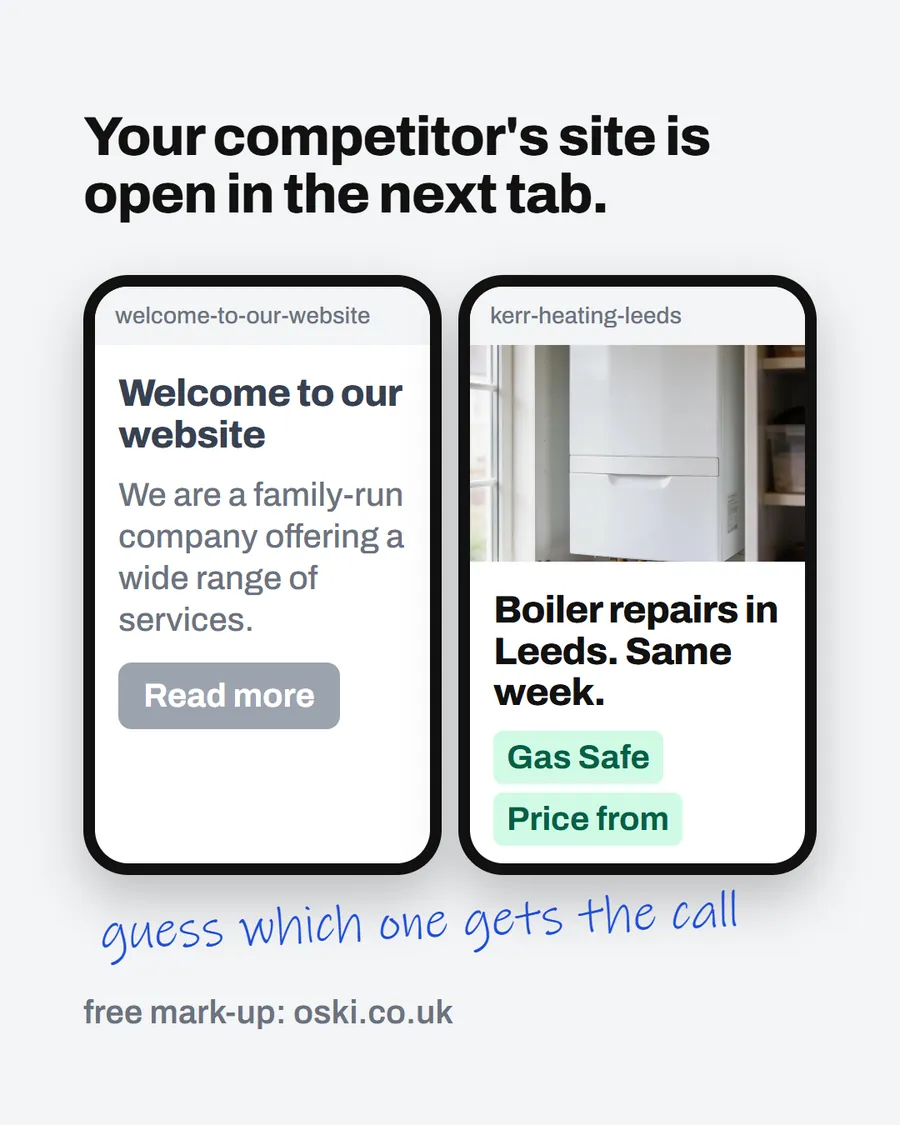
| "We are a company that offers a wide range of services" | "We repair and fit boilers in Leeds" |
| "Customer satisfaction is our number one priority" | "Quoted on the phone before we set off" |
| "High-quality, professional solutions" | Name the actual job |
| "Welcome to our website" | Delete it |
| "Contact us today for more information" | "Call us on [number]" |
| "Years of experience" | The number of years, or a registration |
Notice that each replacement is more specific. Specific wording is easier to say, easier to believe and easier to remember.
How do you rewrite what fails?
Take the first failing sentence and ask: what is the plain version? Say what you do, where, and one thing that makes you a safe choice. For an example heating engineer in Croydon, that might be "Boiler repairs and servicing in Croydon. Gas Safe registered. We quote on the phone before we set off." That is three short sentences, and each does a job.
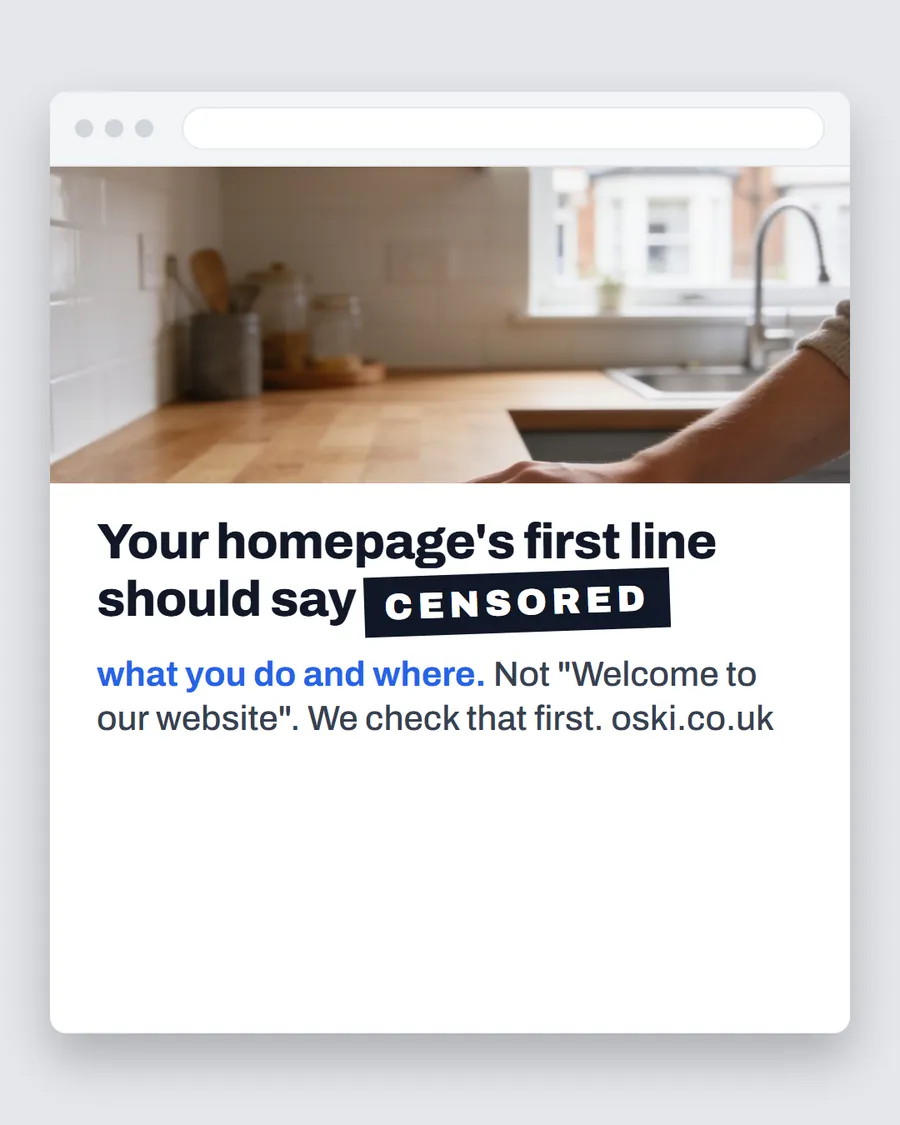
Our guides on what the first line of your homepage should say and writing a homepage that gets calls give the full formula.
What else should you check by ear?
While you are listening, notice a few more things:
- Jargon. Terms you use daily that a customer would not know.
- Repetition. The same promise made three times in different words.
- Long sentences. Anywhere you ran out of breath.
- Missing answers. Where you expected the page to say something and it did not, such as your area, your hours or how to book.
- Tone. Does it sound like you, or like a brochure?
Fix them one at a time. You are aiming for a page that sounds like a helpful person talking, not a committee.
Does it matter for search as well?
Plain, specific wording helps people and search engines, because it matches how customers describe their problem. A page that says "boiler repairs in Leeds" has a better chance of matching a search for exactly that than one that says "heating solutions". We explain the location side in why your town needs to be written on your website.
Do not stuff the page with keywords to please a search engine, because it will sound strange read aloud, and that is the test.
What if you cannot hear the problem yourself?
Some owners know their own words too well to hear what is wrong. If that is you, hand the job to someone else. Ask a friend to read the first screen aloud to you while you listen, with your back to the phone so you cannot see the page. Listen for where they pause, change tone or look confused.
Another trick is to read the page backwards, one sentence at a time, starting from the bottom. This breaks the flow and makes each sentence stand on its own, so empty ones stand out. If a sentence still tells you something useful on its own, keep it. If not, cut it.
How often should you repeat the test?
Every time you change the page, and once a year regardless. Small edits add up. A line added for a promotion, a phrase borrowed from a competitor or a new service tacked on at the bottom can slowly turn a clear page into a muddle. A two-minute read-through catches it before customers do.
It also works for other writing. Try it on your Google description, your social bio, your quotes and your email signature. Anywhere customers read about you is a place where plain speech helps.
What to do this week
- Record yourself reading your homepage aloud.
- Listen back and mark every sentence that sounds like nothing.
- Rewrite the first three using the plain-English approach above.
- Ask a friend who does not know your business what they think you do and where.
- If you would like us to rewrite your first line for you, send us your web address.
Frequently asked questions
What is the read-it-out-loud test?
You read your homepage aloud, ideally recording it on your phone, and listen back. If you stumble, get bored or would never say those words to a customer, the page needs rewriting. It takes two minutes and needs no tools.
Why does reading aloud help?
Because writing for the web often drifts into stiff, formal phrases that nobody says in conversation. Hearing it exposes filler, repetition and sentences that go nowhere, which are hard to see on the screen.
What should I do if my homepage sounds boring?
Cut every sentence that does not tell a customer what you do, where, why to trust you or how to reach you. Replace long phrases with short ones, and write as if you were answering a customer on the phone.
Should I get someone else to read it?
Yes. Ask a friend who does not know your business to read it aloud and tell you what they think you do. Where they stumble or misunderstand, a customer would too.