What Should the First Line of Your Homepage Say? A Formula for Local Businesses
The first line of your homepage should say what you do and where, in the words a customer would use, such as "Boiler repairs and servicing in Leeds". Replace "Welcome to our website" with that, then add one reason to trust you and a way to get in touch. It takes minutes and it changes what visitors understand in the first second.
The ad at a glance
| Question | Answer |
|---|---|
| Who it is for | Owners whose homepage opens with a greeting or a slogan, and who have never tested what a stranger learns from the first line. |
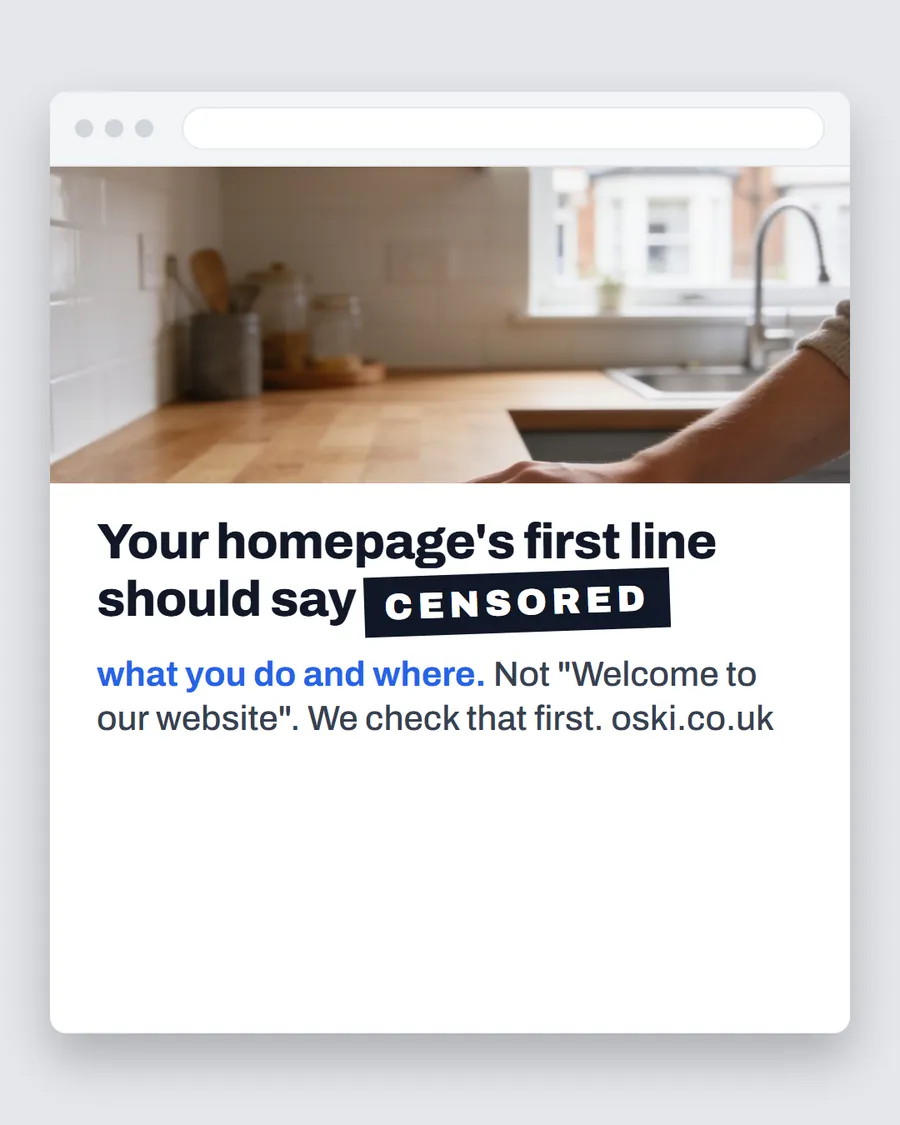
| What it shows | A browser window showing a trade homepage with a job photo and the headline "Your homepage's first line should say CENSORED", followed by "what you do and where. Not 'Welcome to our website'. We check that first." |
| Where it applies | Across the UK, with a focus on London and the South East, where we are based. It is aimed at small local businesses wherever customers search for them. |
| Why we published it | The censored bar makes people pause and guess, and the answer is something they can fix in a minute. |
Why does the first line matter so much?
Because it is read first and, for many visitors, last. Someone who lands on your page decides within seconds whether they are in the right place. The first line is the cheapest way to tell them. If it says "Welcome to our website", they have learned nothing, and they look for answers elsewhere, or leave.
It matters to search engines too. Google's SEO starter guide says titles should be clear, concise and accurate about the page, and that headings help readers and search engines understand a page. A first line that names your trade and place does both jobs.
What is the formula?
Three parts, in this order:
- What you do, in the customer's words.
- Where you do it, as a town or area.
- One reason to trust you, if you have room.
Put together: "[Trade] in [place]. [One proof]." Then your call button. That is all. You can add a second sentence about how you work, but the first line stands alone.
What does it look like for different trades?
Here are examples, all for fictional firms.
| Trade | First line |
|---|---|
| Heating engineer | Boiler repairs and servicing in Croydon. Gas Safe registered. |
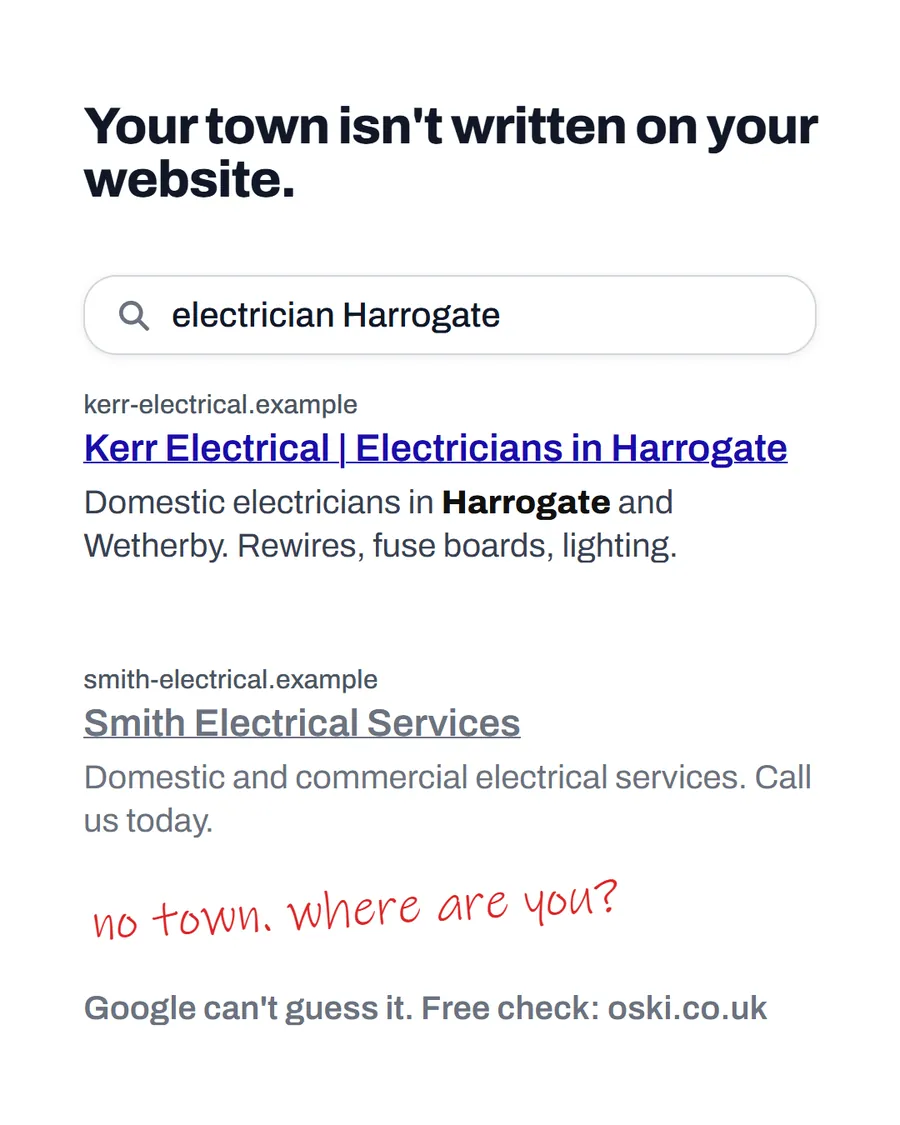
| Electrician | Electricians in Harrogate and Wetherby. Fully insured, free quotes. |
| Roofer | Roof repairs and new roofs in Leeds. Written quotes, no pressure. |
| Locksmith | Emergency locksmith in Manchester. Here within the hour where we can. |
| Bathroom fitter | Bathroom fitting in Bristol. Tidy, on time, with a fixed price. |
Notice that each uses plain words, names a place and offers a proof you can check or deliver. If you cannot back up the proof, leave it out. For example, only say "within the hour" if you usually manage it.
What should you avoid?
Some openings waste the space. Avoid:
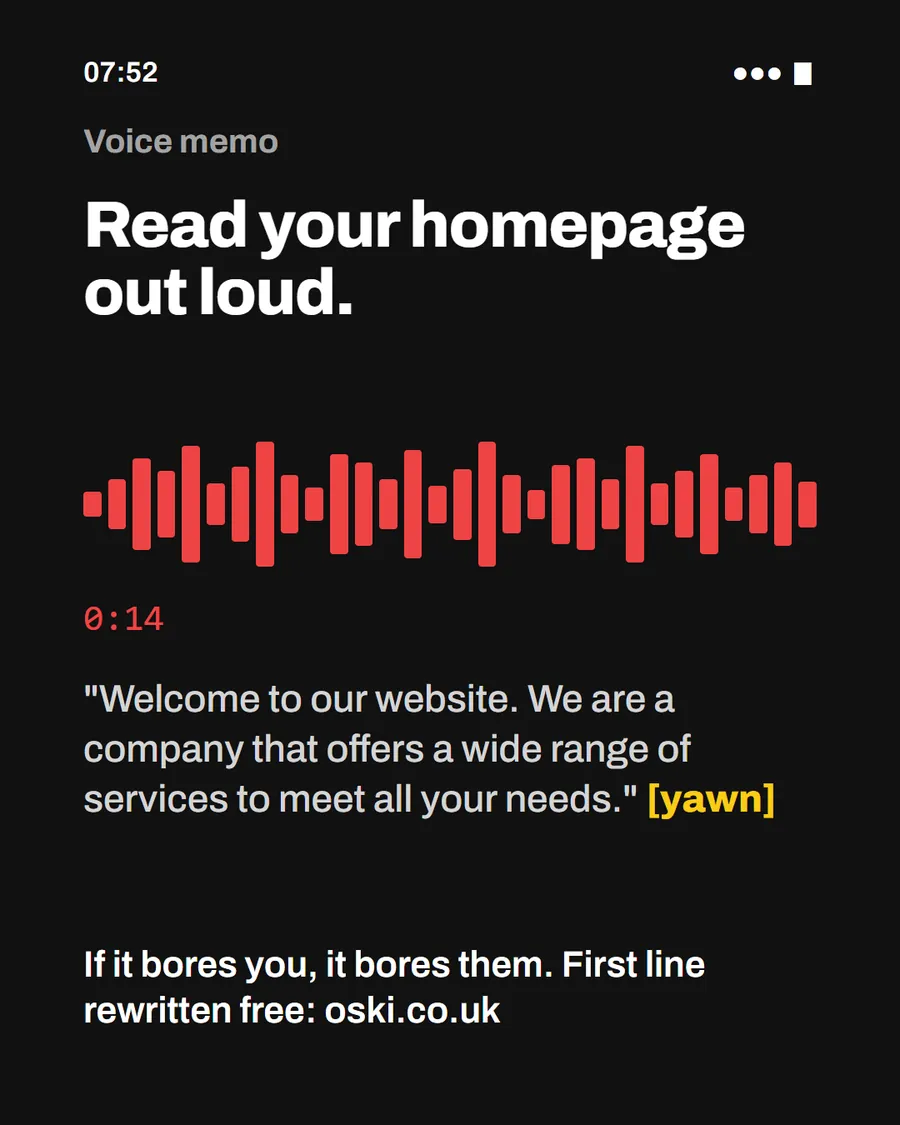
- "Welcome to our website." It says nothing.
- "We are a company that offers..." It sounds like a form letter.
- Slogans with no content. "Quality you can trust" could be any firm.
- Jargon. "Domestic heating solutions" instead of "boiler repairs".
- A list of everything you do. Lead with the main service and list the rest lower down.
If you read the line aloud and it sounds like something a person would never say, rewrite it. Our read-it-out-loud test shows how.
Where else should the same line go?
Use it, or a close version, on your Google listing description, your social bios, your quotes and your van, as we describe in what to put on a work van and your website. Consistency helps customers recognise you, and it saves you writing something new each time.
Put the town in the page title as well, which Google's guide says can include the location of a local business, and in the footer, as we explain in why your town needs to be written on your website.
How do you test your new first line?
Show it to someone who does not know your business, for ten seconds, and take it away. Ask them what you do and where. If they can tell you, it works. Then check it on your phone, where the line should appear above the first scroll, with a call button close by.
Give it a few weeks, and note whether more people mention the service you named, or ring about it. If the line brings the wrong kind of enquiry, adjust the service you lead with.
Does every page need its own first line?
Yes, and it is a good habit. Your service pages and area pages are often where customers land from a search, so each should open with a line that matches. A boiler page might begin "Boiler servicing in Croydon", and a roofing page "Roof repairs in Leeds". Each line says what the page is about and where, so a visitor who arrives deep in your site knows they are in the right place.
What if you do several different jobs?
Lead with the one customers ask for most, or the one you want more of, and mention the others in a second line. "Plumbing and heating in Croydon" is fine if that is genuinely how customers describe you. If your services are very different, give each its own page and a clear link from the homepage, rather than squeezing everything into one headline. A focused first line beats a long list.
What to do this week
- Read the first line of your homepage aloud and write down what a stranger would learn from it.
- Rewrite it using the formula: trade, place and one reason to trust you.
- Check the page title in your browser tab says the same thing.
- Show it to someone for ten seconds and ask what you do and where.
- If you want us to rewrite your first line for you, send us your web address.
Frequently asked questions
What should the first line of a homepage say?
What you do and where, in the words a customer would use. For example, 'Boiler repairs and servicing in Leeds'. Add one reason to trust you and a way to get in touch straight after.
Is 'Welcome to our website' bad?
It is not harmful, but it uses your most valuable space to say nothing. The first line is the first thing a visitor reads, so use it to tell them they are in the right place.
Should the first line include my business name?
Your business name belongs in the logo and page title. The first line should be about what the customer needs. If your business name already says what you do, you can include it, but still add the place.
How long should the first line be?
Short enough to read in a breath. A line of five to ten words, followed by one short sentence, is usually plenty. If you need to break it up, you are saying too much.