What Matters Most on a Tradesperson's Website? A Ranked List
On a tradesperson's website, real photos of finished jobs matter most, followed by a starting price and recent reviews. Correct opening hours and a clear first line come next. Stock photos and motivational graphics sit at the bottom, because they say nothing about your work. Fix them in that order if you have limited time.
The ad at a glance
| Question | Answer |
|---|---|
| Who it is for | Trade owners who are unsure what to prioritise on their site, or who have been sold design extras they do not need. |
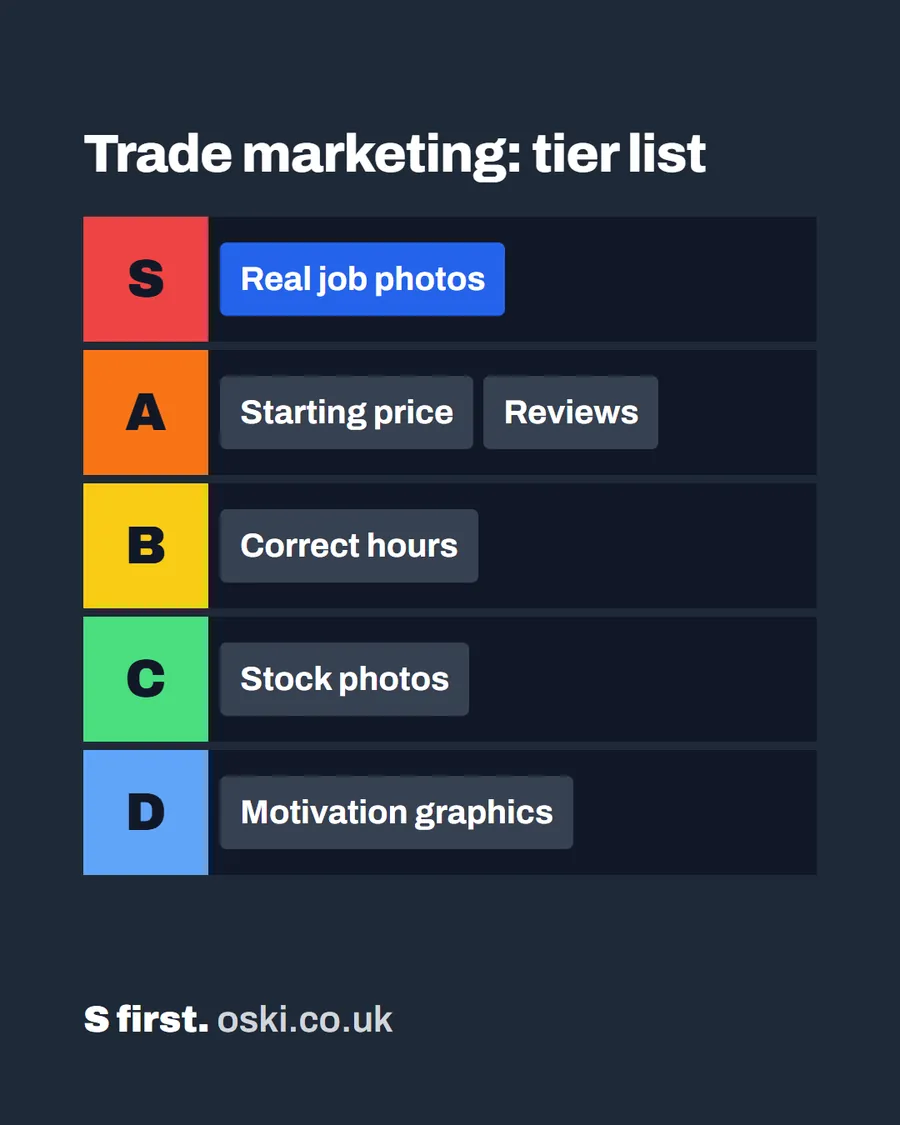
| What it shows | A dark tier-list screen headed "Trade marketing: tier list" ranking real job photos in S, a starting price and reviews in A, correct hours in B, stock photos in C and motivation graphics in D. The caption reads "S first." |
| Where it applies | Across the UK, with a focus on London and the South East, where we are based. It is aimed at small local businesses wherever customers search for them. |
| Why we published it | Tier lists are familiar and quick to read. This one turns a vague "what should I do first?" into an order. |
How should you read a tier list like this?
Treat it as a ranking of what moves a customer's decision, not of what costs most. S means do this first. D means it can wait, or never happen. The ranking is our view, based on how customers compare firms, and you should adapt it to your trade and area. A locksmith may weight a tappable number higher, while a bathroom fitter may rely more on photos.
The point is to make you choose. Time is limited, and a list that says "everything matters" helps nobody.
What belongs in S tier?
Real photos of finished jobs. They are proof that you can do the work, and they cannot be faked by a template. A few clear photos of your own jobs beat any amount of copy. Google's photo guidance asks for photos that are in focus and well lit and says images should represent reality.
If you do one thing this week, add real photos. Our guide on using photos of your work to get more jobs shows how.
What belongs in A tier?
A starting price and recent reviews. A price tells a customer whether you are in the right range and takes away the fear of an unexpected quote. Reviews tell them other people were happy, and a recent one tells them you are still working.
Both need care. A price must be accurate and not mislead, and reviews must be genuine, which means asking real customers and never offering anything in return. See how to ask for a Google review for what is allowed.
What belongs in B tier?
Correct hours and basic details. They do not win jobs on their own, but wrong ones lose them. A customer who sees "closed" when you are open goes elsewhere. Check your hours, phone number and address on your site and your listing, as in fixing wrong opening hours on Google.
Other things we would put here: a clear first line, a tappable phone number and a short contact form. Each is quick to fix, and each removes a small reason for doubt.
What belongs in C and D tier?
| Tier | Item | Why it ranks low |
|---|---|---|
| C | Stock photos | They tell the customer nothing about your work and often look generic |
| C | Long "about us" paragraphs | Customers skim them; a short version is enough |
| D | Motivational quotes and graphics | They take space without proof |
| D | Sliders and auto-playing animation | They distract and slow the page |
| D | Pop-ups that cover content | They annoy visitors on a phone |
None of these is harmful in tiny doses. The problem is when they take the place of S-tier and A-tier items.
How should you use the list?
Go through your own site and place each element in a tier. Be honest. Then see where the gaps are. Many sites have a lot in C and D and little in S. The fix is to add S-tier items and cut or shrink C and D ones.
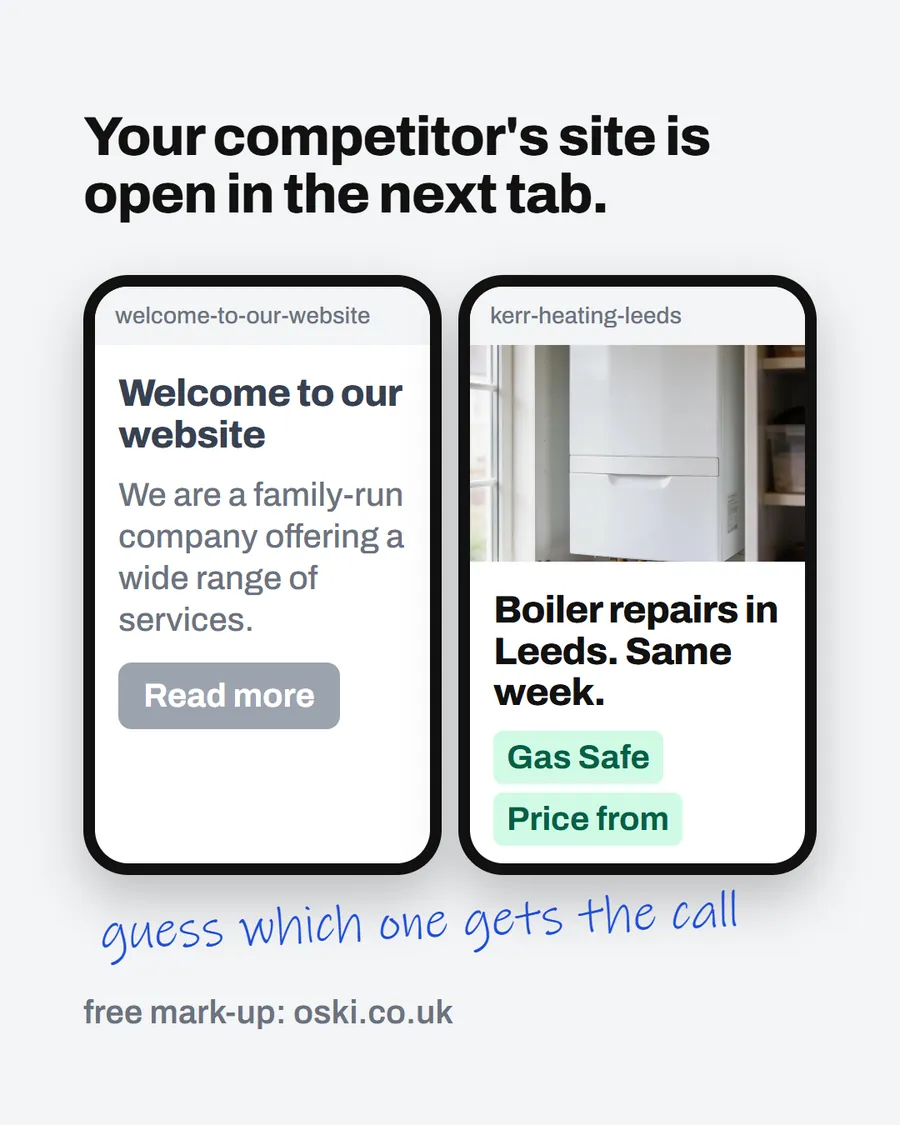
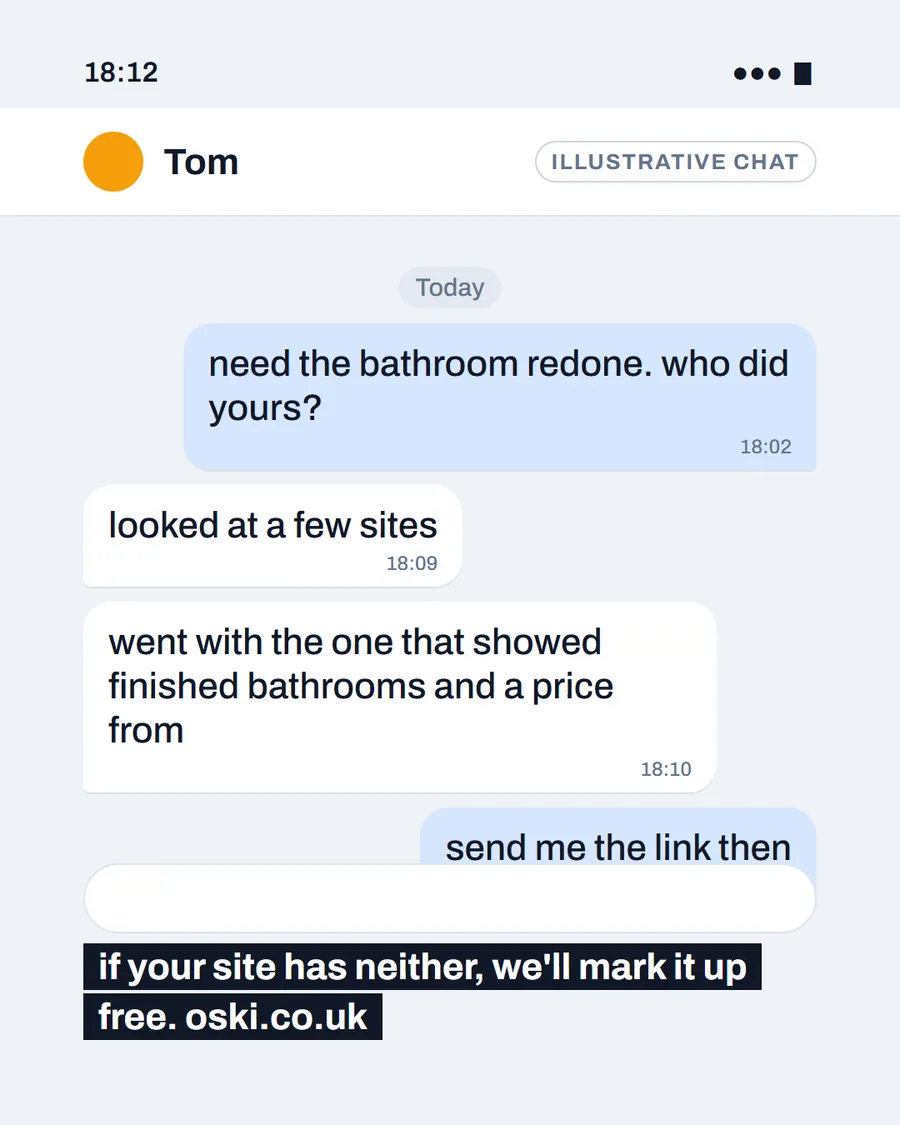
If you are short of time, the order is: photos, price, reviews, hours, first line. Our post on how customers compare two tradespeople's websites shows how those items work together when a customer has two tabs open.
What about things that are not on the list?
Plenty. Page speed, mobile layout, service pages, area pages, a clear about page and structured data all matter, and some belong high in the ranking for particular trades. The list is a starting order for a small site, not the full picture. For a fuller checklist, read our website launch checklist.
How does the ranking change by trade?
The order shifts a little depending on what you do. An emergency locksmith or plumber should put a tappable number and clear hours at the top, because customers are in a hurry. A bathroom fitter or roofer should lean harder on photos and reviews, because the job is bigger and the decision slower. An electrician may need registration details near the top, because trust in safety work matters.
Use the list as a starting point, and think about what your customer is worried about when they search for you. Put the answer to that worry where they will see it first.
Does design matter?
It matters less than clarity. A clean, readable layout helps, but a plain page with strong photos and a clear first line will beat a polished page with nothing to say. If you need to choose where to spend money, put it into getting real photos and good words before a redesign. Our guide to whether you need a new website or just three fixes explains how to decide.
What to do this week
- List the ten main elements on your homepage and place each in a tier.
- Add three real photos if you have fewer than five.
- Add a starting price or an explanation of how you quote.
- Check your hours and phone number on your website and listing.
- If you want us to place your site on the list, send us your web address.
Frequently asked questions
What are the most important things on a tradesperson's website?
Real photos of finished work, a clear first line saying what you do and where, a starting price or explanation of how you quote, recent reviews and a phone number that can be tapped. Everything else supports those.
Do I need a blog on my trade website?
Not at first. A blog can help over time with local searches, but a clear homepage, service pages and real photos matter much more. Add a blog only if you will keep it up.
How many pages does a trade website need?
A homepage, a page for each main service, a page for the areas you cover, an about page and a contact page is enough for most trades. Quality beats quantity, and each page should say something real.
Are logos and slogans important?
They help recognition, but customers decide on proof, price and clarity. A logo will not win a job if the page does not show your work. Get the proof right first.