What Should a Tradesperson's Van Say? Copy It Onto Your Website
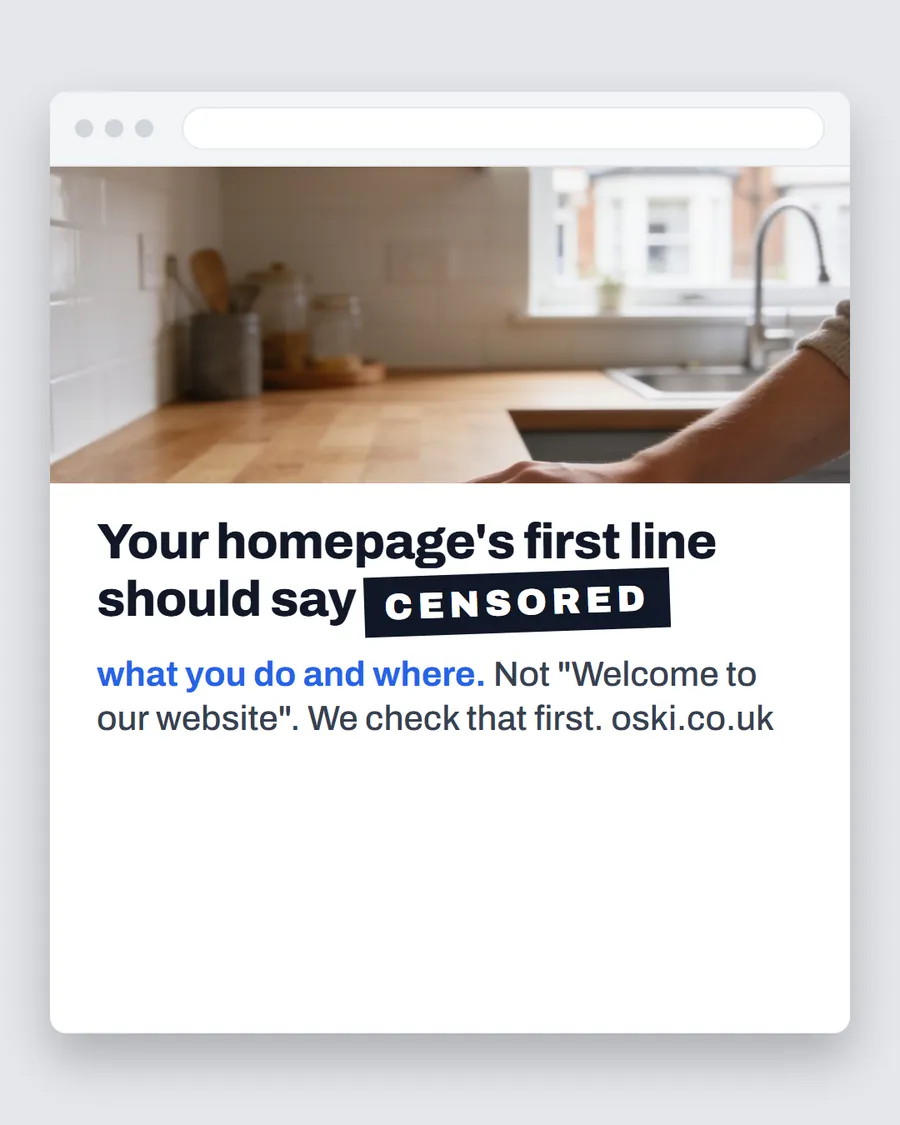
A work van should say three things: what you do, where you do it and one reason to trust you. Your website needs exactly the same three lines at the top of the homepage. A van usually gets this right because space is tight, while websites often do not, so copying the van onto the site is the fastest fix.
The ad at a glance
| Question | Answer |
|---|---|
| Who it is for | Owner-operators in the UK trades: plumbers, heating engineers, electricians, roofers and builders who have paid for van lettering and then left the website saying "Welcome". |
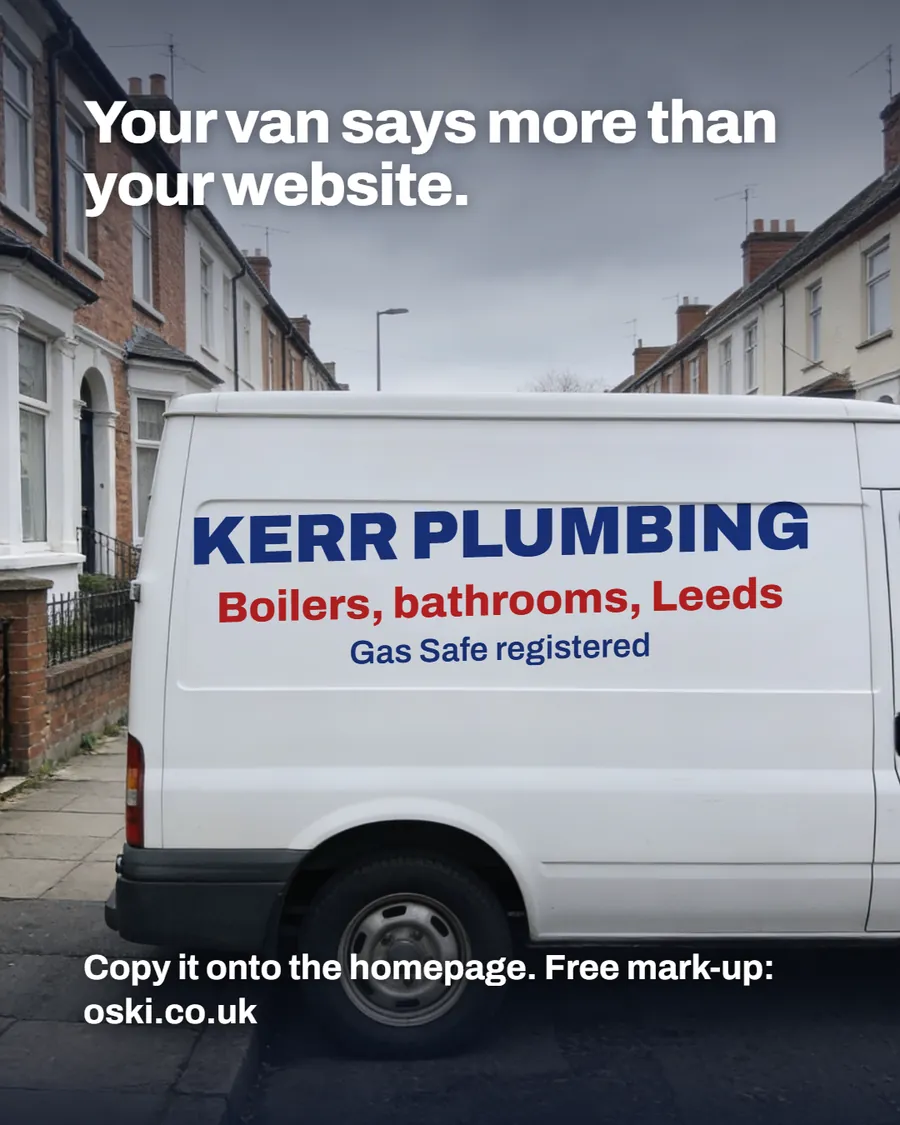
| What it shows | A plain white van with a trade name, a services line and a trust mark on the side, under the headline "Your van says more than your website." The plumbing firm on the van is an example, not a client. |
| Where it applies | Across the UK, with a focus on London and the South East, where we are based. It is aimed at small local businesses wherever customers search for them. The example firm in the ad is set in Leeds, and the same advice applies in any town. |
| Why we published it | The quickest website fix a tradesperson can make costs nothing. They already wrote the right first line when they lettered the van. |
What should a tradesperson's van say?
A van has about as much space as a good homepage headline, which is why the wording tends to be sharp. Signwriters ask for three lines, and the best vans follow the same order:
- The trade, in the words customers use. "Boilers, bathrooms" beats "Domestic heating and sanitary solutions".
- The place. One town or area, not a list of twelve postcodes.
- One reason to believe you. A registration, a guarantee or how you price. Pick the one that answers the customer's biggest worry.
Contact details come after those lines. Anyone reading the side of a moving van will not take in more than that, and the discipline is useful. If you cannot get your offer onto the side of a van, you probably cannot get it into a customer's head either.
Why does the website often say something different?
Because a website has unlimited space and nobody is forcing a decision. Owners fill it with "Welcome", a paragraph about being family-run and a list of every service they have ever done. The result is a page that takes thirty seconds to say what a van says in three.
There is also a practical reason. The van was lettered once, by a professional who asked what you do. The website was often built from a template or by a friend, and nobody asked the same question. Our guide to homepage copy walks through the full formula, but the short version is that the van already contains it.
How do you turn van lettering into a homepage headline?
Follow these steps with the photo of your van open in front of you:
- Copy the trade line as it appears on the van. If the van says "Boilers, bathrooms", the headline starts there.
- Add the place. "Boilers and bathrooms in Leeds."
- Add a short sentence about how you work. Same-week visits, fixed prices quoted before you arrive, tidy workers.
- Show the trust line as text, not an image. Registration numbers should be readable and copyable so customers can check them.
- Add a tap-to-call button. A
tel:link makes a phone dial straight away, as MDN's documentation explains for devices that can make calls.
Here is a before and after for an example heating engineer in Croydon.
| Homepage first line | |
|---|---|
| Before | Welcome to our website. We are a family-run company with years of experience. |
| After | Boiler repairs and servicing in Croydon. Gas Safe registered, number shown below. Quoted on the phone before we set off. |
The "after" version contains everything a van would, in the same order, and nothing a customer has to read twice.
Where else should the same three lines go?
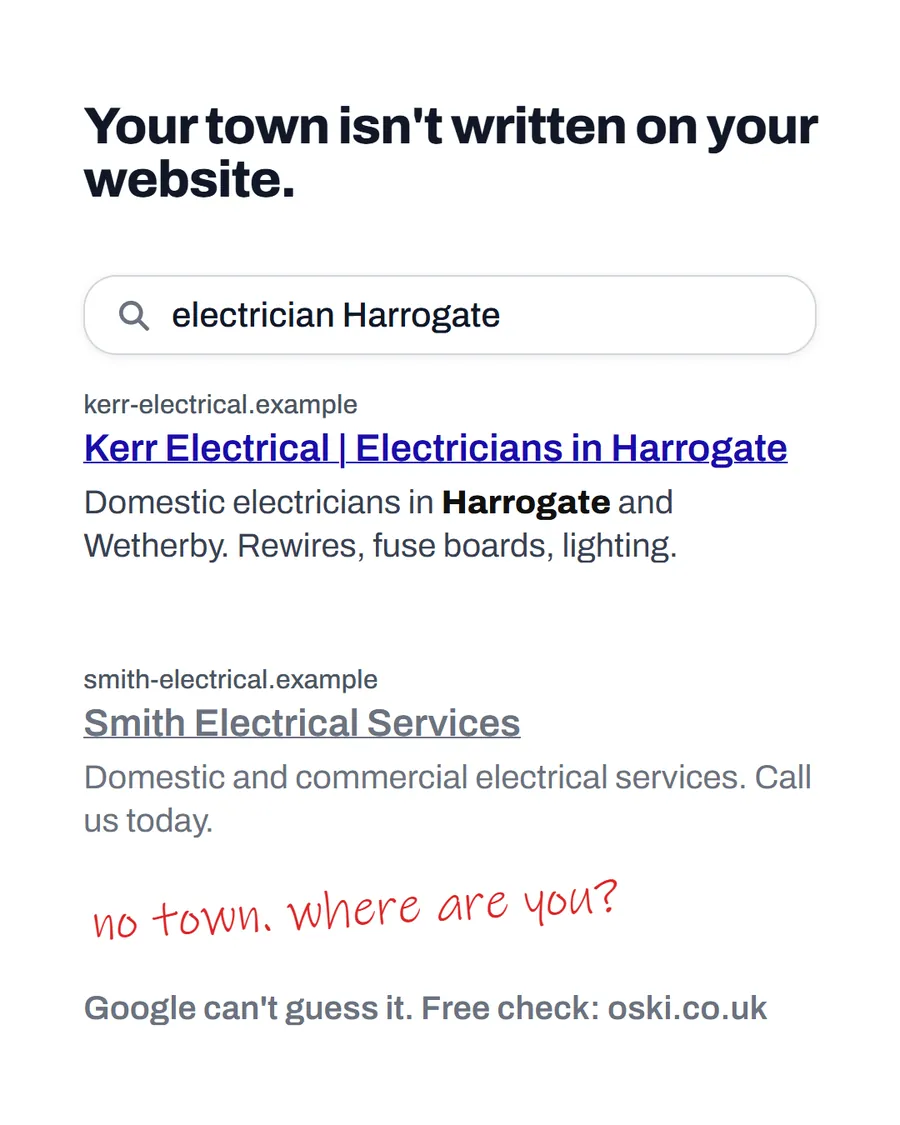
Anywhere a customer meets you before they speak to you. Consistency matters because people often see the van, look you up on their phone and then compare you with other firms, as we describe in how customers choose between local search results.
| Place | What to copy |
|---|---|
| Homepage headline | Trade, place, trust line |
| Google Business Profile description | The same sentence, written out in full |
| Facebook and Instagram bio | Trade and place, with a link to the website |
| Quotes and invoices | Trade line and registration number |
| Email signature | Trade, place and phone number |
Google's own SEO starter guide suggests a page title can include important details such as the physical location of the business, and that titles should be clear, concise and accurate about the page. A title like "Boiler Repairs in Leeds | Business Name" does that job in a single line.
What mistakes should you avoid when copying the van?
- Listing every service. A van has no room for twelve services, and neither does a headline. Put the main one first and the rest lower down.
- Claiming something the van does not. Do not add accreditations to the website that you do not hold or cannot show.
- Using a phone number as an image. If it is a picture, nobody can tap it, and screen readers cannot read it.
- Forgetting the van needs updating too. If you have moved into a new area or dropped a service, update both at the same time so they keep matching.
What to do this week
- Take a photo of your van, side on, in daylight.
- Write the three lines from it on a piece of paper: trade, place, trust.
- Open your homepage on your phone and check whether those three lines are above the first scroll.
- If they are not, change the first line and the button. Keep the rest of the page as it is for now.
- If you would like a second pair of eyes, send us your website address and we will mark up the homepage the way a customer would read it.
Frequently asked questions
What should be written on a work van?
Your trade, the area you cover and one reason to trust you, such as a registration or a guarantee you can back up. A phone number or web address goes last. If someone only sees the van for three seconds at a junction, those lines are all they will remember.
Should the website say the same as the van?
Yes. The same trade, area and trust line should open your homepage. Customers often see the van first and the website second, and a mismatch makes them wonder whether they have found the right firm.
Do I need to put my phone number on the van and the website?
Put it on both. On the van it should be large enough to read at a glance. On the website it should be a tappable link at the top of the page, so someone on a phone can ring without typing.
Can I put accreditations on my van and website?
Only ones you hold, and only wording you can back up with a registration number or certificate. Check the rules of the scheme itself, and show the number on your website so customers can verify it.